One of the things people say after loss (almost always with good intentions) is, “I hope things get back to normal soon.”
I understand why people say it. Normal feels comforting. Familiar. Safe. It gives us this idea that life can somehow return to what it was before everything changed. And when you’re watching someone you care about struggling, “back to normal” sounds like the kindest thing you can wish for them.
The problem is — sometimes there is no “back.”
Not because life is ruined forever. Not because healing is impossible. But because certain experiences change us deeply enough that returning to the exact version of ourselves that existed before them simply isn’t realistic. And spending years trying to get there can exhaust you in ways you don’t even fully recognize while it’s happening.
Grief did that to me.
For a long time, I think part of me was waiting to feel like myself again — without fully realizing that the version of myself I was trying to get back to no longer existed in the same way. That’s not meant to be dramatic, just honest.
Loss changes your perspective. It changes your routines, your relationships, your priorities, your emotional landscape, your sense of safety … and sometimes even your sense of identity. Parts of you absolutely remain intact. But other parts shift permanently. And pretending otherwise doesn’t make the shift less real. It just makes you feel like you’re failing at something that was never actually possible.
I think a lot of people get stuck here because they believe healing means restoring the old life exactly as it was. Like if you just work hard enough, grieve long enough, push through enough… you’ll eventually arrive back at the person you used to be.
But what if healing is less about restoration and more about adaptation? What if it’s not about going backward at all, but about learning how to live honestly as the person you are now?
That realization took me a while.
Nearly two years after Bob died, I had a dream. Or maybe a visitation — honestly, I’m not sure the label matters as much as the feeling itself. There weren’t really words in it. It was more like a knowing. A feeling that he was saying goodbye in a way he hadn’t been able to before.
When I woke up, something felt different.
I wasn’t fixed or suddenly healed. I certainly wasn’t free of grief, but I just felt… lighter. Even though part of me still didn’t want to let go.
But I also knew — clearly, in a way I hadn’t before — that something in my life needed to change. Because I had reached a point where just surviving wasn’t enough anymore. If I stayed exactly where I was emotionally, professionally, personally… I genuinely felt like the grief would eventually swallow me whole.
That became what I now think of as my “ENOUGH!” moment.
Not angry. Not impulsive. Just deeply, somehow clear.
I quit my job. Started a completely different career. Changed my life in ways that probably looked jarring from the outside. And around that same time, I started dating again, too.
Looking back now, I don’t think any of those choices were about moving on from Bob. I think they were about finally giving myself permission to keep living. And there’s a real difference between those two things.
Because I believed that staying emotionally frozen somehow honored the depth of the love and the loss. Like continuing to suffer was proof that what we had mattered. Like, if I started living again — really living — it would mean I was leaving him behind.
I don’t believe grief asks us to stop living.
What makes this so hard is that growth after loss can feel genuinely disorienting. Sometimes, even disloyal. You start noticing parts of yourself changing, and it creates this strange internal conflict. Part of you wants to move, and part of you wants to hold tightly to everything that was. To keep the world exactly as it was the last time they were in it.
And honestly? Both parts deserve compassion. It’s human, not wrong.
But I also think a lot of people exhaust themselves trying to recreate a version of life that no longer fits who they’ve become, or who they are becoming. They keep reaching backward, hoping to feel exactly the way they once did. Measuring themselves against a life that no longer exists. And wondering why they keep coming up short.
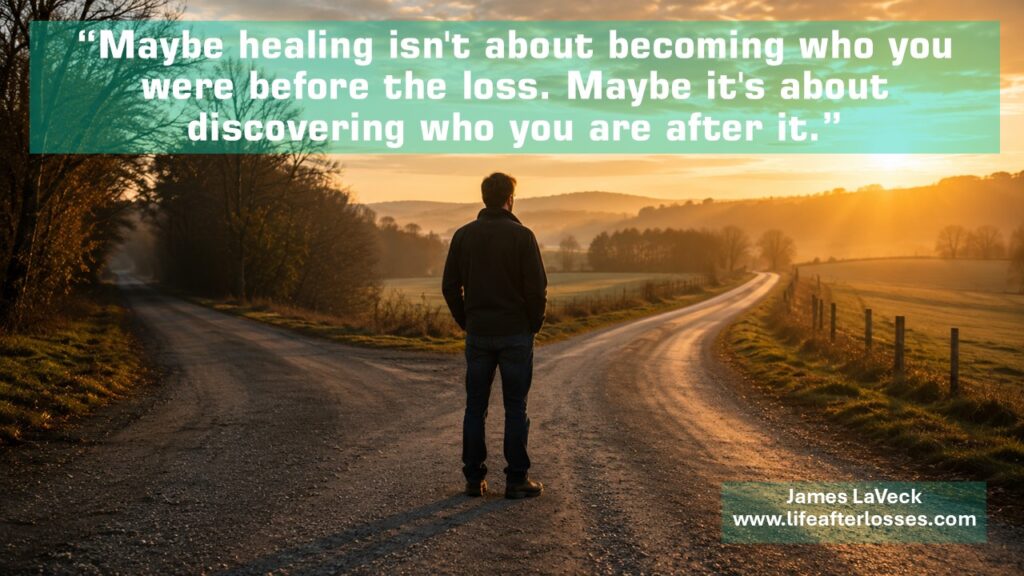
After all these years, I’m thinking that maybe healing isn’t about becoming who you were before the loss.
Maybe it’s about discovering who you are after it.
That doesn’t mean forgetting. It doesn’t mean the grief disappears or that the waves stop coming. There are still days, even now over 30 years later, when something hits unexpectedly, and I’m right back in it for a moment. That’s just true.
But over time, life starts asking us for something different. Not “How do you return?” But — “How do you live now?”
That is a very different question. And I think part of healing is allowing the answer to evolve, instead of forcing yourself back into an old shape that no longer fits.
A different life may emerge from loss. Not better. Not worse. Just…. different. And sometimes, if we allow ourselves to actually live it, that life can still hold love, purpose, connection, laughter, meaning, creativity, peace, and joy.
Not because the loss stopped mattering.
But because we did not stop being alive.
Your turn.
This week, take some time to think about this:
Is there a part of your life you keep trying to get back to? What if the pressure to return is actually making it harder to move forward honestly?
How have your experiences changed you — not just painfully, but personally?
And if healing isn’t about becoming who you used to be… who might you still become from here?