I left my work phone at home the other night.
That shouldn’t feel particularly noteworthy. But lately, it does.
I’ve been winding down several projects at the same time, which has meant long days, working at night, being available well past the point when I’d normally consider myself done, and — I’ll just say it — sleeping with my phone. For the most part, that’s been necessary. These projects have deadlines, specific challenges, and things that only I can handle. Sometimes the work genuinely needs more of me.
But recently I hit a major milestone on one of them. There was still work to do — there’s always still work to do, if I’m being honest — but I’d reached the point I’d been working toward. So I decided I was going out with friends to recharge my social batteries.
And then I did something very deliberate.
I left the work phone at home. Not silenced in my pocket. Not tucked in my bag just in case. Not sitting on the table where I could glance at it every time the screen lit up. I left it at home.
You’ll be relieved to know the world did not explode. I was relieved when I checked it the next morning. Nothing collapsed because I was unavailable for a few hours. Whatever happened while I was gone was still there when I got back. I spent time with friends, laughed, relaxed, and gave myself a chance to actually recharge after a stretch when most of my energy had been going somewhere else.
Mostly, I got to enjoy a few hours of my life on my own terms.
That phrase has been rolling around my noggin for a bit. Over the last couple of weeks I’ve written about claiming ten minutes when our days are crowded, and then about claiming our attention once we’ve decided where we want to be. But there’s another piece of intentional living I think matters just as much, and it’s this: we have to make choices. And here’s the part we sometimes forget — we also get to make them.
That sounds obvious. “Duh, James… of course we make choices, we make hundreds of them every day!” But I’m talking about something more specific — the moments when we stop waiting for circumstances to create the opening we want, and start deciding what to do with the opening we actually have. You may not have an hour, but you may have 20 minutes.
Nobody was going to tell me I was officially finished. My work phone wasn’t going to look at the hours I’d put in and say, “You know what, James — you’ve done enough, go have fun.” There was never going to be a magical moment when every project was complete, every email answered, every possible issue resolved, and nobody could conceivably need anything from me. If that was the standard, I probably would have stayed home.
So I decided the work could wait.
Now, I want to be careful here, because I don’t think every demand on our time is optional. Jobs have expectations. Children need us. People care for aging parents or sick partners. Sometimes somebody genuinely needs us, and there isn’t much choice about where the next hour goes. Intentional living doesn’t make those realities disappear.
But I wonder how often we take the parts of our lives that aren’t entirely ours to control… and then accidentally hand over the parts that are. We wait until work settles down. We wait until everyone else’s needs have been handled. We wait until we’ve somehow earned the rest, the dinner, the afternoon, the hour on the couch, whatever it is. Tell me you don’t see yourself a little in that waiting. I see a lot of myself in it.
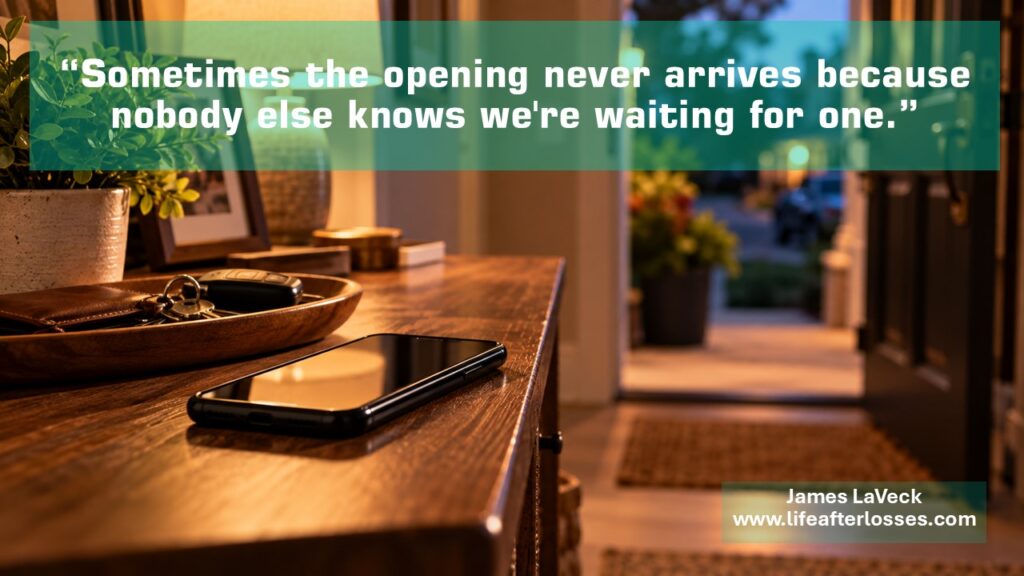
Here’s the thing though… sometimes the opening never arrives because nobody else knows we’re waiting for one.
Part of being here, I think, is recognizing that we’re allowed to make some of those decisions ourselves. Responsibly, yes. With the people who depend on us in mind, absolutely. But our responsibilities mattering doesn’t mean our lives don’t matter too.
This has also been on my mind because I’m getting ready to turn sixty, and I’ve been planning something around the sixty days leading up to my birthday. I’ve hinted at it before, and I’ll share more about it soon. The basic idea is simple — I want to put a little more life into life. It’s right there in the name of this blog, after all.
Some days that might mean doing something I’ve never done. Some might mean time with people I care about. Some might be fun, some reflective, some completely ordinary.
And because I’m me — naturally, I’ve started making a project out of it. What else would a project manager do? There are ideas. There are plans. There’s a calendar. Apparently, I can project-manage having fun.
But I’ve also realized something important while putting it together. The calendar isn’t the point. If I wake up one morning and don’t want to do whatever I had planned, I have a choice. Maybe I’ll do it anyway because I know I’ll enjoy it once I get moving. Maybe I’ll change it. Maybe I’ll do absolutely nothing. If I turn those sixty days into sixty more obligations I have to complete successfully, I’ve completely missed my own point.
The intention isn’t in checking off the activity. It’s in making the choice.
Intentional living doesn’t mean doing more, or squeezing maximum value out of every available hour, or turning our lives into another improvement project we’re supposed to execute correctly. Sometimes, it means deciding to work late because something really matters to us. Sometimes it means answering the phone because somebody needs us. And sometimes it means deciding the phone is staying home tonight.
All three can be intentional choices. That’s the part I think is easy to miss.
I don’t need complete control over my day to have some say in how I live it. There will always be things that decide parts of my day for me — responsibilities, commitments, other people, circumstances I didn’t choose. But when a choice actually is mine, I don’t want to keep waiting for someone or something else to make it for me.
The other night, the choice was pretty simple. The phone stayed home. I went out with my friends. The world kept turning. And when I came home, the work was waiting for me.
So was the rest of my life.
Your Turn
This week, notice one choice about your time that you’ve been waiting for someone or something else to make for you. Have you been waiting for work to slow down, for everyone else to be taken care of, for the calendar to magically open up on its own? Ask yourself, “What part of this decision is actually mine?”
You may not control the whole day. But if there’s a piece of it that belongs to you, decide what you want to do with it.