Thirty years. It still feels impossible to say that. This month marks thirty years since my first major loss.
Grief has a strange relationship with time. On paper, three decades should feel like a lifetime. But in the body, in the heart, it can still feel like yesterday. Sometimes I catch myself remembering a moment so vividly—how the air felt, the sound of a laugh, the way everything shifted in an instant—and I realize: that kind of loss doesn’t vanish. It integrates itself into who you become.
I was young when it happened–just a 28-year-old kid. Too young to fully grasp the shape grief would take in my life. Too young to know that the long road ahead wouldn’t be a straight line or something that could be neatly wrapped up in five stages. I didn’t have the words then. I only had the ache.
And yet, here I am, thirty years later, not “over it,” not “past it,” but changed by it. Shaped. Grown. Still healing, in some ways. Still bumping into the parts of me that carry that early wound.
One of the biggest lessons I’ve learned in these thirty years? You don’t wait for grief to be done before you start living again. You can’t wait.
Because if I had waited until I felt “better,” I might still be waiting.
There were birthdays I showed up for with tears in my eyes. There were holidays where laughter came with a lump in my throat. There were conversations, performances, big decisions, quiet moments—all peppered with sadness or anxiety or uncertainty. I’ve gone to weddings holding joy and envy in the same breath. I’ve danced while my heart ached. I’ve celebrated while quietly grieving what might have been.
And still, I lived.
I didn’t always feel ready. I didn’t always feel whole. But I kept showing up.
And over time, that’s what made the difference. Not a sudden breakthrough. Not waking up one morning miraculously “healed.” But the slow, frequently clumsy, always courageous choice to participate in life again.
That’s what no one tells you early on. That healing doesn’t arrive in a box with a bow. That sometimes, life moves forward before your heart is ready—but that doesn’t mean you’re doing it wrong. It just means you’re human.
So if you’re reading this and you’re waiting—waiting to feel okay, waiting to feel like yourself again, waiting for the day it won’t hurt so much—I want you to hear this:
If you wait until you feel better to start living, you might be waiting forever.
Go live your life.
Do it sad.
Do it anxious.
Do it uncertain.
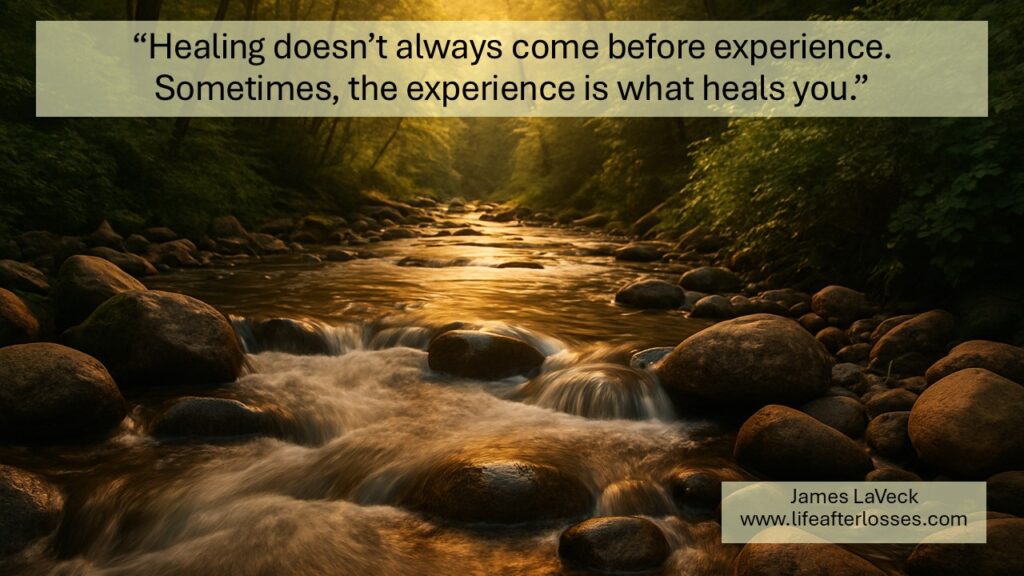
Because healing doesn’t always come before experience. Sometimes, the experience is what heals you.
And no, that doesn’t mean forcing yourself to pretend everything’s fine. Who has the energy for that? It means letting yourself show up exactly as you are. It means giving yourself permission to live inside the mess, not beyond it, and not to worry about what other people think.
Grief is a lifelong companion—but so is joy. So is curiosity. So is connection. You don’t have to choose one over the other. You just have to stay open enough to let more than one thing be true at the same time.
If I could go back and tell myself anything from 30 years ago, it might just be this:
You don’t have to wait to feel whole before you start living again. You just have to begin.
Because the first step back into life isn’t always a big one. Sometimes it’s just saying yes when you’d rather say no. Sometimes it’s taking a walk even though hiding under the sheets feels safer. Sometimes it’s letting someone in, just a little. Sometimes it’s choosing not to disappear.
So here’s your invitation—for this week, or this day, or even just this hour: Take the walk. Make the call. Sing the song. Book the trip. Start the thing.
Do it anyway.
What’s one thing you’ve done—even when you didn’t feel “ready”—that helped you come back to life?