There’s a moment during our grief journey that doesn’t seem to prompt much conversation.
It’s not the early shock.
It’s not the raw pain.
It’s not even the slow realization that life has changed forever.
It’s a quiet moment that comes later, when grief is no longer the loudest thing in the room.
At some point, the questions shift. You’re no longer waking up asking, How do I get through today? Instead, something else begins to surface: How do I actually want to live now?
That question can feel disorienting. After all, for a long time, survival was enough. Endurance was the goal. Getting through the day without falling apart felt like progress. And then, without much warning, grief loosens its grip just enough to make room for something else.
Choice.
When I created the PURPOSE framework for Grief Recovery for Adults, it was built for this phase of figuring out what’s next. It was designed for people who felt disconnected from meaning after loss, people who were trying to make sense of a world that no longer looked the way it used to. It wasn’t meant to tell anyone what their purpose should be. It was meant to help them rediscover agency, direction, and a sense of self in the aftermath of loss, on their own path.
What I didn’t expect was this: the concepts behind PURPOSE didn’t lose their relevance once grief softened. They kept showing up.
I began to notice people using the language of PURPOSE not just in grief, but in moments of transition, uncertainty, creativity, and growth. I noticed myself returning to it when making decisions that had nothing to do with loss and everything to do with living. The framework that once helped me survive was quietly asking a different question.
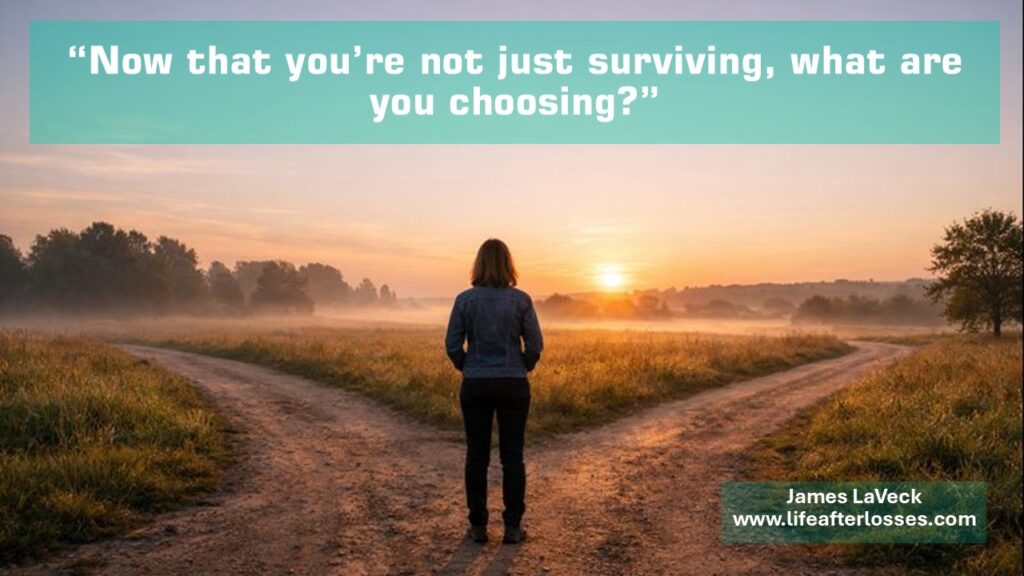
Now that you’re not just surviving, what are you choosing?
That’s a harder question in many ways. Grief gives us a reason to slow down, to opt out, to pause life indefinitely. But when grief is no longer the primary reason we feel stuck, we’re left face-to-face with our own hesitation. Fear of choosing wrong. Fear of wanting more. Fear of stepping into a life that no longer has grief as its central organizing force.
And that fear often gets mislabeled.
People assume they’re regressing. That something is unfinished. That maybe they didn’t grieve “well enough” because restlessness has replaced devastation. But what I’ve come to understand is this: when grief quiets, intention gets louder.
The discomfort is an invitation.
Purpose doesn’t require crisis. Meaning doesn’t require tragedy. Intention doesn’t need to be born from pain. But grief has a way of teaching us how to ask better questions. It strips away distractions. It forces honesty (if we’re honest). It removes the luxury of living on autopilot. And once you’ve learned how to live that way, it’s hard to go back.
That’s why PURPOSE doesn’t end when grief changes shape. It evolves.
Living intentionally after loss isn’t about replacing grief with joy or pretending everything is fine. It’s about recognizing that survival is no longer the only metric. At some point, endurance stops being enough. The question becomes less about how much you can carry and more about how you want to engage with the life that’s still here.
This is where many people feel unsteady. There’s no roadmap for this phase. No clear rules. No obvious next step. Just a growing awareness that something inside you wants more than maintenance. More than coping. More than simply getting through.
And that awareness can feel uncomfortable, especially if you’ve spent years focused on healing.
But here’s the thing I’ve learned, both personally and through my work with others: PURPOSE isn’t something you complete. It’s something you return to.
It meets you differently at different stages of life. It looks one way when you’re shattered and another when you’re rebuilding. And eventually, it begins to ask questions that aren’t about grief at all, but about alignment. About honesty. About how you want to live, love, create, and show up now.
If you find yourself wondering why old questions don’t quite fit anymore, that doesn’t mean you’ve lost your way. It may mean you’ve grown beyond the season that first required them.
So here’s my gentle invitation for this week.
If you’re willing, notice what question is showing up for you now. Not the one about survival, but the one underneath it. Ask yourself:
What feels restless that isn’t grief anymore?
Where am I being asked to choose, not just endure?
What part of my life is asking for intention instead of patience?
You don’t need answers yet. You don’t need a plan. Sometimes, noticing the question is the work.
PURPOSE didn’t stop mattering when grief softened. It simply started asking something different.
And that might be worth paying attention to.