There was a time when survival was the goal.
Getting through the day was enough.
Holding it together was enough.
Not collapsing was enough.
And during that time of my life, surviving wasn’t weakness. It took every bit of courage to do so.
Many of us have lived in that space.
We’ve navigated loss.
We’ve absorbed impact.
We’ve rebuilt after things fractured.
And in those moments, survival is not small. It’s everything.
But survival isn’t meant to be permanent.
There comes a point when the crisis that demanded all of your attention is no longer running the show. The loss is still part of you. The history is still real. But you are no longer in free fall.
And that’s where something subtle — and maybe a little uncomfortable — can happen.
We keep speaking the language of survival long after we’re stable.
We describe ourselves as barely holding on.
We default to endurance.
We explain our hesitation by pointing to what we’ve been through.
Sometimes that’s still true.
And sometimes it’s not.
Survival can become a shield.
It protects us from expectation.
It protects us from risk.
It protects us from having to choose something new.
If we’re still “in recovery,” we don’t have to stretch.
If we’re still “getting through it,” we don’t have to build.
If we’re still “just surviving,” we don’t have to risk wanting more.
That language feels safe because it once was the truth.
At some point, though, it stops being protection and starts being cover.
It starts to become an excuse for not living. Now, let me be clear… that’s not an accusation. It’s an observation. Been there, done that. And I’ve seen it many times.
There’s a difference between honoring what you endured and continuing to define yourself by it.
We don’t have to erase the struggle.
We don’t have to minimize the pain.
We don’t have to pretend it didn’t shape us.
But we also don’t have to keep hiding behind it.
When survival is no longer the only goal, the question changes.
Not: How do I get through this?
But: What am I choosing now?
That’s a harder question.
Because choice requires ownership.
Choice requires intention.
Choice requires us to stop pointing backward and start looking forward.
It’s easier to endure than it is to build.
It’s easier to stabilize than it is to expand.
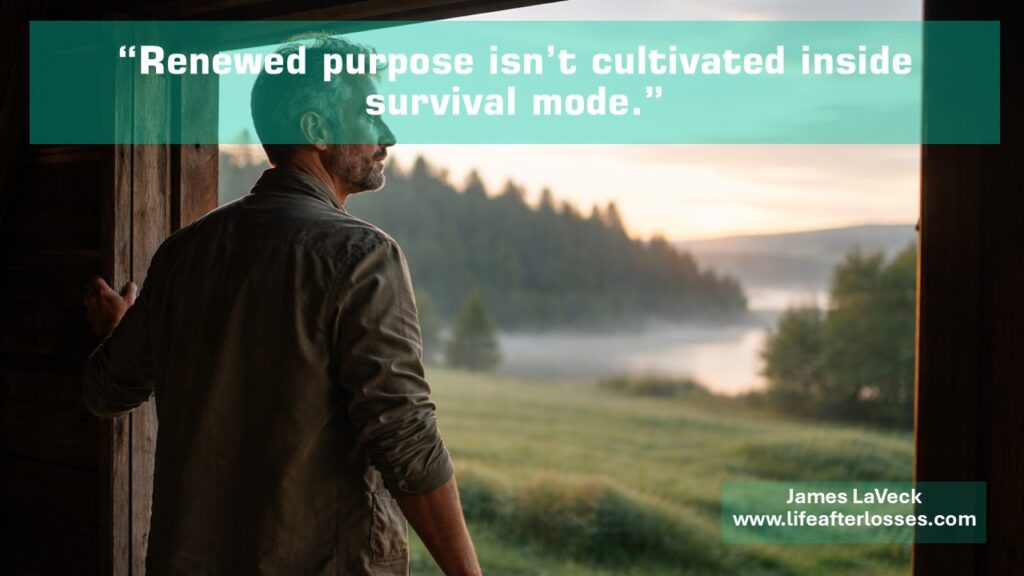
But renewed purpose isn’t cultivated inside survival mode.
It grows when we admit that we are no longer just trying to stay afloat.
It grows when we acknowledge that stability, even imperfect stability, gives us options.
We may not feel ready.
We may not feel certain.
We may not feel fully healed.
But healing isn’t a prerequisite for growth.
And survival isn’t the final destination.
Staying in survival mode feels justified.
It explains our pace.
It explains our reluctance.
It explains why we’re not stepping into something bigger.
But if we’re honest, sometimes it also protects us from discomfort that has nothing to do with loss anymore.
Fear of failing.
Fear of choosing wrong.
Fear of wanting something new and not getting it.
Survival kept us focused on endurance. Building requires exposure.
When you’re surviving, expectations are lower.
When you’re building, responsibility rises.
And responsibility can feel heavier than grief ever did.
Because grief happened to us.
Choice belongs to us.
That’s the pivot.
There comes a point where we are no longer reacting to what happened.
We are responding to what is possible.
That doesn’t mean the past disappears.
It means it stops being the only explanation for why we aren’t moving.
Renewed purpose isn’t about denying what we endured.
It’s about refusing to let endurance be the ceiling.
We can be grateful for survival.
And still admit that we are capable of more than maintenance.
So maybe the better question isn’t, “Are we still surviving?”
Maybe it’s this: “Where are we using survival language to avoid building something new?”
Again, not shaming. It’s about being aware.
And awareness is where agency begins.
We survived.
That took courage.
Now building will take intention.
And intention requires us to step forward without the shield. Because we have something to build—not something to prove.
That might be worth considering.