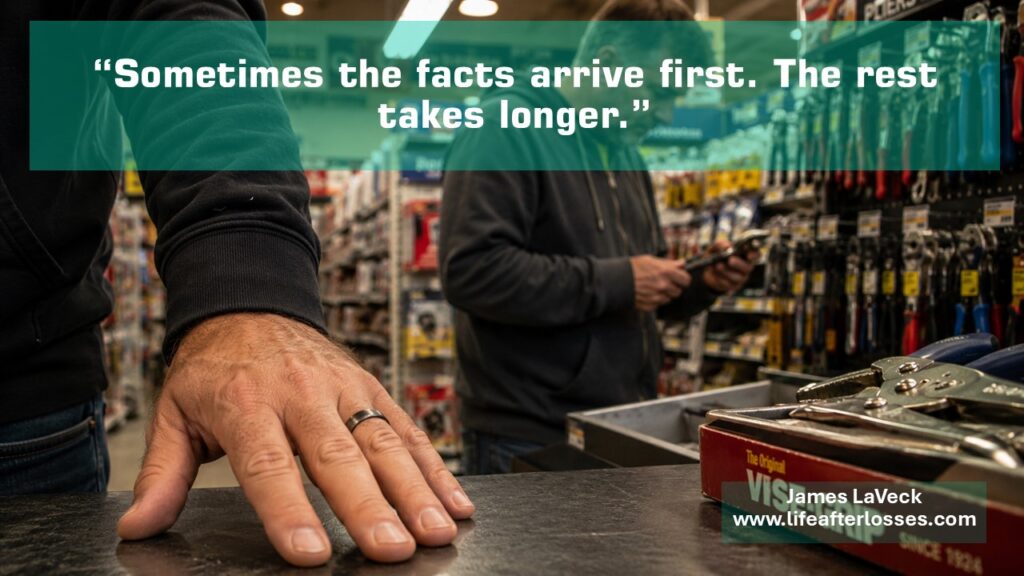
A few days ago I found myself standing beside a friend with a pair of vice grip pliers, helping him break his wedding ring off his finger.
Not exactly how either of us expected the afternoon to go.
He’d decided a few weeks earlier that he was ready to take the ring off. His marriage was ending, and even though he’d known that for a while, removing the ring felt like a step he was finally ready to take. There was just one problem. It wouldn’t come off. The ring would move around his finger just fine, but it wasn’t getting over his knuckle. He tried all the usual tricks. Nothing worked. So he did what any of us would do — he went down a research rabbit hole about what you’re actually supposed to do when a wedding ring simply refuses to leave your finger.
His happened to be made of tungsten steel, which presents its own particular challenge. The advice he found gave him two options: go to the fire department, or use vice grips to carefully break it. So there we were, standing in the local DIY store, picking out a pair of pliers that would get the job done.
There was something genuinely strange about helping someone physically break apart the symbol of a marriage that was ending. And when the ring finally cracked and I looked at the pieces sitting there, my first thought was probably the obvious one — what a metaphor.
But what my friend said afterward has stayed with me a lot more than the broken ring itself.
He’d known the marriage was over for weeks, he told me. Taking the ring off wasn’t going to change the outcome. It was already what it was. And there was something in the way he said it — matter of fact, no drama — that struck me as genuinely wise. The ring was a symbol. An important one. But wearing it couldn’t keep the marriage together any more than removing it could end something that had already ended. Reality didn’t depend on what was on his finger.
I’ve thought about that several times since, partly because I’ve had my own experiences with the moment when the symbols of a life and the reality of that life stop matching up. My losses were different from his — the death of a spouse and the end of a marriage through divorce aren’t the same experience, and I’d never pretend they are. But loss doesn’t have to be identical for us to recognize something in each other. There can be a strange gap between knowing something has ended and actually figuring out what life looks like because it has. Sometimes the facts arrive first. The rest takes longer.
A relationship ends. A career ends. The kids leave home. Health changes. Someone dies. A role that once took up an enormous part of your identity just isn’t yours anymore. And eventually you’re left looking at the life that’s still here, asking a different set of questions. What matters to me now? What am I building toward? What does a good life look like from here? In other words, your why starts to shift.
I don’t think we always notice how much of our motivation gets organized around the life we’re currently living. When we’re part of a couple, we plan as a couple. When we’re raising kids, countless decisions revolve around them. Careers can organize decades of our lives. Relationships shape where we live, what we do on weekends, what we picture when we imagine the future. None of that is bad — it’s just life. But when one of those things changes, the motivations attached to it can change too.
I’ve experienced that more than once. There were versions of my future built around people who aren’t here anymore. Things I wanted because we wanted them together. Plans that made sense because of the life we were building. When those lives ended, there was no clean dividing line where the old motivations disappeared and new ones arrived. I had to live my way into the questions. Some things continued to matter. Some mattered differently. Some stopped mattering at all. And other things became important that I never could have imagined beforehand.
Maybe that’s why my friend’s comment felt like such a hopeful sign. Not because he has everything figured out — he doesn’t, and there’s still a lot ahead of him. But he wasn’t asking the ring to tell him what was true. He already knew. And there’s an acceptance in that I recognized. Not the same as liking what happened. Not the same as being finished grieving. Just the ability to look at life as it actually exists, instead of asking the symbols of the old one to keep it alive.
The ring came off. The marriage was still over. But now there was one less thing connecting the reality of today to the appearance of yesterday.
Maybe that’s where the next questions begin. Not — how do I get my old life back? But — what actually matters to me in the life I have now?
That’s a harder question. It’s also one that can eventually lead somewhere real.
Your Turn
This week, I’d like you to sit with the question: What matters to me in the life I have now?
Big or small, if it matters to you now, it’s worth noticing.