There’s something about January 1 that carries an outsized amount of power.
We treat it like a starting gun. A line in the sand. A moment that’s supposed to separate who we were from who we’re about to become. And with that date comes an unspoken agreement: this is when success or failure will be defined.
Not gradually. Not thoughtfully. But decisively.
If we stick to the plan, we’re succeeding. If we don’t, we’ve failed.
It sounds neat. Motivating, even. And yet, year after year, it leaves a lot of people feeling deflated, ashamed, or convinced they just “can’t stick with anything.”
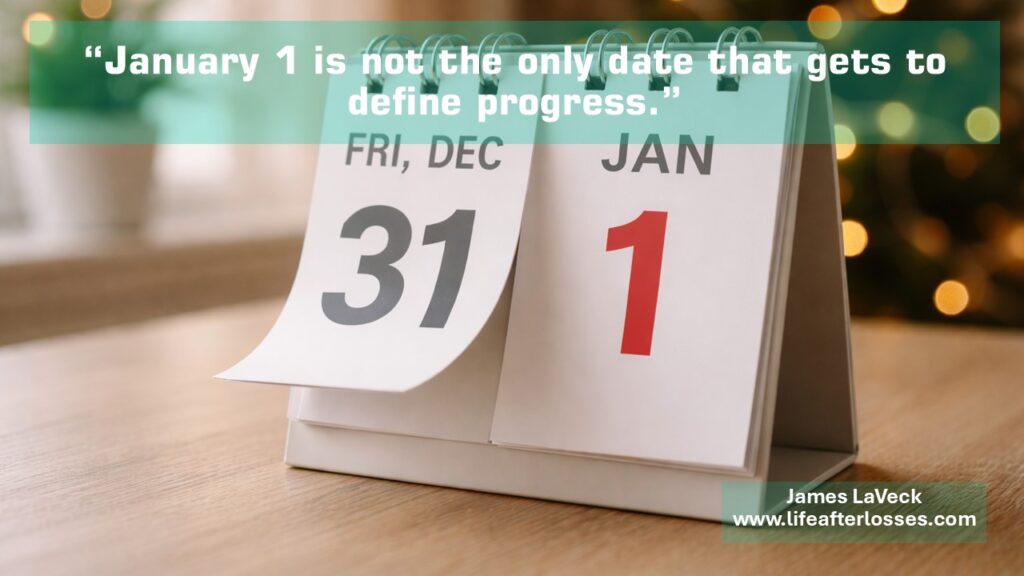
Here’s the myth I want to challenge: January 1 is not the only date that gets to define progress.
The Problem With Arbitrary Deadlines
New Year’s resolutions don’t usually fail because people are lazy or undisciplined. They fail because we attach unrealistic expectations to an arbitrary date.
We ask January to do far too much heavy lifting.
We expect clarity. Momentum. Visible results. Motivation that doesn’t waver. All neatly packaged into a few short weeks. And when real life shows up — because it always does — we interpret the disruption as failure instead of information.
We rarely stop to ask a more honest question: Is this timeline actually realistic for the change I’m trying to make?
Because meaningful change doesn’t follow the calendar. It follows consistency, patience, and a willingness to keep going when things don’t look impressive.
A Personal Example of “Failure” That Wasn’t
At the beginning of 2025, I committed to a 90-day health challenge. I showed up. I followed the plan. I completed the challenge.
And by the metric that mattered most to me at the time — weight loss — I failed.
I didn’t lose what I wanted to lose. Not even close.
If January 1 had been the only date that mattered, and March 31 the final verdict, that would’ve been the end of the story. Another example of effort without payoff. Another freaking disappointment filed away under “why bother?”
But that wasn’t the end of the story.
Over the rest of the year, without fanfare or pressure, I made small, sustainable changes. Nothing dramatic. Nothing Instagram-worthy. Just daily decisions that were doable and realistic.
And now, at the end of the year, I’m at a weight I haven’t seen since December 2018.
The thing is, if I’d quit when I “failed,” none of that would’ve happened.
What looked like failure in the spring turned out to be progress by December.
Why We Confuse Failure With Timing
We’re conditioned to believe that results must arrive on schedule or not at all. That if the outcome doesn’t show up fast enough, the effort didn’t matter.
But effort doesn’t expire just because a date passes.
Sometimes the work you do today doesn’t show up as visible change until months later. Sometimes the discipline you build quietly becomes the foundation for something that only makes sense in hindsight.
Failure, more often than not, isn’t the absence of progress. It’s progress that hasn’t revealed itself yet.
Releasing the Pressure of January 1
January 1 doesn’t need to be the moment you prove anything.
It can simply be another day you continue showing up.
What if instead of resolutions with deadlines, you set intentions without timelines?
What if success wasn’t measured by speed, but by willingness to keep going?
What if you allowed progress to be uneven, imperfect, and still valid?
Daily progress doesn’t have to be dramatic to be meaningful. It just needs to happen.
Some days, progress looks like momentum. Other days, it looks like maintenance. And some days, it looks like learning what doesn’t work, and figuring out the next step.
All of it counts.
A Different Way to Think About the New Year
Look, I’m not against hope. I’ve been sharing “hopeful” content for over 5 years.
I’m also not against intention. I’m not even against using the new year as a moment of reflection.
I am against tying your worth, your discipline, or your belief in yourself to a single date on the calendar.
January 1 doesn’t get to decide whether your effort mattered. March doesn’t get to declare you a success or a failure. And December doesn’t get to rewrite your story if you’ve been showing up all along.
Change is happening whether the calendar acknowledges it or not.
Your Turn
As the year turns, I want to invite you into a gentler, more honest way of approaching change.
Ask yourself:
- Where have I labeled something a failure simply because it didn’t happen fast enough?
- What effort have I dismissed that might still be working quietly in the background?
- What intention could I carry forward without attaching a deadline to it?
Progress doesn’t need a starting gun. It doesn’t need permission from January.
And it doesn’t need to look impressive to be real.
Sometimes the most meaningful changes are the ones you only recognize when you look back and realize how far you’ve come — even though it never looked like success at the time. That lens of reflection can be powerful.
And that might be the most hopeful truth of all.