For as long as I can remember, I’ve been socially adaptable.
In high school, I could move easily between groups—the jocks, the theater kids, the mathletes, the 4-H farm kids. I didn’t feel out of place in any of those spaces. I could read the room, understand the energy, and meet people where they were.
At the time, I didn’t think much of it. It just felt normal.
Later, I realized that skill shaped a lot of my life. It’s one of the reasons I gravitated toward consulting. Every new project brought a different environment, a different culture, a different way of thinking. I didn’t get bored because I was constantly adapting. Observing. Adjusting. Translating myself just enough to belong.
For a long time, I thought that was simply versatility.
Only later did I understand something else was happening.
I had learned how to present the version of myself that fit the space I was in.
And grief complicated that more than I expected.
When Competence Gets Mistaken for Closure
I think this is one reason people sometimes assume I’m “over” my grief.
I function well. I communicate clearly. I show up. I work. I laugh. I connect. I don’t fall apart publicly very often.
So from the outside, it can look like resolution.
But living well and being done grieving are not the same thing.
What many people don’t realize is that adaptability can make grief invisible. When you’re good at reading a room, you instinctively decide how much of yourself feels welcome there. And sometimes, grief doesn’t feel like it fits the space—especially when others aren’t carrying it themselves.
So you adjust.
You present the version of yourself that won’t make things uncomfortable. The version that reassures others you’re “okay.” The version that doesn’t require explanation. The version of yourself that makes others comfortable with your grief.
And over time, that version becomes the one people expect.
Who Gets Which Version of You
I’ve noticed something interesting over the years.
When I’m with other grievers, there’s very little pretense. There’s an unspoken understanding. We don’t need to explain why a date matters or why something small hits hard. The truth of our existence as bereaved people is already known.
But with people who haven’t experienced that kind of loss, the dynamic can be different.
Not because they’re unkind or because they don’t care. They simply don’t have the context. Totally understandable, right?
So we self-edit.
We smooth the edges. We offer the “best face.” We downplay the moments when an anniversary sneaks up, or an unexpected trigger knocks the wind out of us. We say we’re fine when what we really mean is, “I’m managing.”
And sometimes, we do that so well that no one realizes we’re carrying anything at all.
The Cost of Self-Editing
Now, here’s the part I’ve had to be honest about with myself: when I consistently hide my truth, even gently, even politely, I’m not protecting connection—I’m limiting it.
Hiding parts of ourselves doesn’t foster closeness. It creates a kind of emotional distance that can look like harmony but feels like loneliness.
And I don’t mean oversharing. I don’t mean trauma-dumping. I don’t mean turning every conversation into a grief seminar.
I mean honesty.
The kind that says, “I’m in a funk today because something old got stirred up.” Or the kind that says, “I’m okay, but this week is heavier.”
It’s the kind of honesty that lets people see you’re human, not resolved.
I have friends who have never lost a spouse. They don’t know that kind of grief firsthand. And still, when I’m struggling because of an anniversary or an unexpected memory, I tell them what’s going on.
Not to be fixed.
Not to be pitied.
But to be known.
And more often than not, they meet me there. And meeting me there is comforting to me.
Honesty Is a Filter, Not a Burden
If you’ve followed my work for any length of time, you know I advocate for honesty.
Honest reflections of feelings.
Honest evaluations of where we are.
Honest assessments of where we’re headed.
That doesn’t mean brutal transparency with everyone. Yourself, yes. But for others who matter to you, it means intentional truth.
Honesty acts as a filter. It clarifies who can meet you in reality and who needs you to stay edited. And while that can feel risky, it’s also how real connection forms.
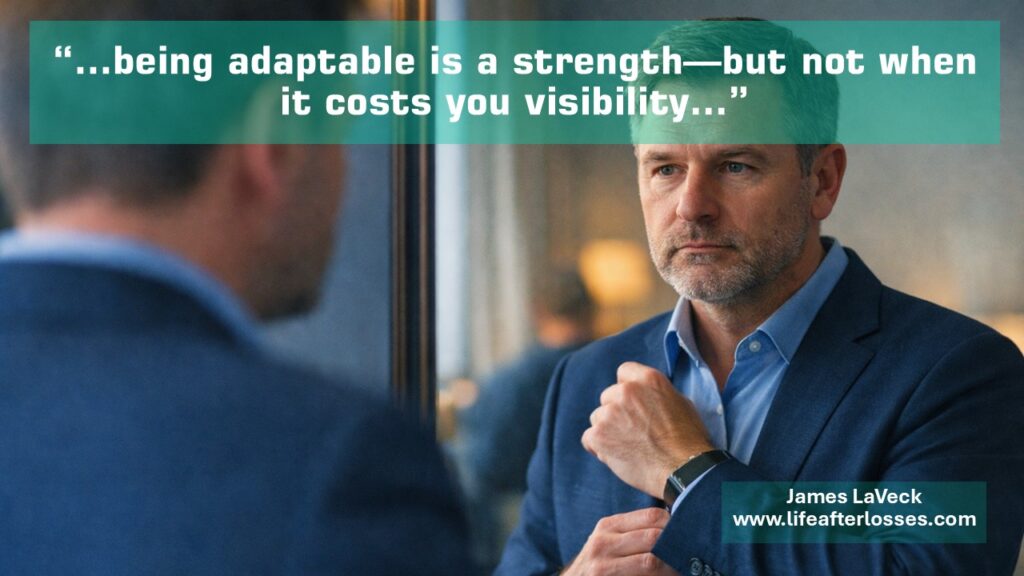
Because being adaptable is a strength, but not when it costs you visibility, not when it convinces others you’re finished with something you’re still carrying, and not when it keeps you performing wellness instead of living truthfully.
A Gentle Question to Sit With
So here’s the invitation I want to leave you with this week.
Ask yourself:
Who gets the honest version of me—and who gets the edited one?
Where am I adapting out of habit instead of necessity?
What part of my truth am I hiding because it feels inconvenient or hard to explain?
You don’t need to change everything.
You don’t need to reveal everything.
You don’t need to stop being adaptable.
But you might consider whether the version of you people see is the one you want to be known for, or simply the one that feels safest to show.
You’re allowed to be capable and grieving. You’re allowed to be functional and affected. You’re allowed to live fully without pretending loss didn’t shape you.
Sometimes the most meaningful connection comes not from fitting the space, but from letting the space stretch to meet you.
And that begins when you decide which version of yourself you’re willing to share.