I get called strong a lot.
Resilient. Grounded. Steady.
And depending on the day, I don’t know whether to feel proud… or exposed.
There are moments when someone says, “I don’t know how you do it,” and I stand a little taller. Because yeah, I’ve survived things I never wanted to face.
I’ve carried losses that could have flattened me. I’ve rebuilt more than once.
But there are other moments when that same compliment makes me uncomfortable.
Because I know me.
I know I’m not always strong.
I know there are days when I don’t want to carry anything. When I’m tired of being the one who handles it. When I’m unsure, frustrated, grieving, restless, or just plain human.
And that’s where the problem begins.
Strength Becomes an Identity
Strength, at first, is a response.
Something happens. Life fractures. You don’t have a choice but to rise.
You show up. You endure. You adapt.
That’s resilience.
But over time, something subtle shifts.
Strength stops being something you did… and becomes something you are.
And once that happens, people start relating to you through that lens.
They expect steadiness.
They expect perspective.
They expect you to have the answer.
They expect you to bounce back.
And here’s a truth I hardly ever hear: When you are known as the strong one, it becomes harder to admit when you’re not.
Not because you’re pretending, but because the role starts to stick.
The Social Reward of Resilience
We reward strength in this culture.
We praise it. We admire it. We post quotes about it. We make cat posters about it.
But we rarely ask what it costs.
Strength can become a form of protection. A shield. A way to avoid being perceived as fragile. A way to maintain control. A way to make other people comfortable with your pain.
If you’re strong, others don’t have to worry about you.
If you’re strong, they don’t have to sit in your uncertainty.
If you’re strong, the room stays stable.
And if you’ve spent years being praised for that steadiness, you may not even realize when it turns into pressure.
I’ve been living in this space more intensely these last few months than I have in years. It takes a lot to push me to the point where that pressure can’t be sustained.
The Quiet Fatigue of Being “The One”
There’s an exhaustion that comes from always being the one who holds it together.
The one who explains.
The one who processes.
The one who models growth.
The one who turns pain into wisdom…
You get it — especially if you’ve ever been a parent.
Sometimes I wonder whether my strength has made it harder for people to see when I’m still carrying something.
Because living well is not the same thing as being done.
Functioning is not the same thing as being unaffected.
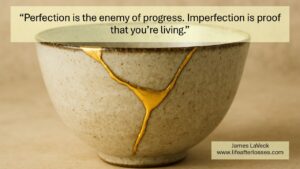
Resilience is not the same thing as having no cracks.
There are parts of me that feel proud of the life I’ve rebuilt. And there are parts of me that would like permission to not have it together.
Both are true. Both can be true.
Strength Got You Through. It May Not Build What’s Next.
So here’s where this gets a little uncomfortable.
Strength is excellent at survival.
It helps you endure.
It helps you stabilize.
It helps you move forward when you don’t want to.
But building a renewed purpose requires something different.
Not just endurance.
Not just grit.
Not just pushing through.
It requires curiosity. It requires desire. It requires softness. It requires the willingness to say, “I don’t know what I want yet.”
That’s not weakness. That’s expansion.
Let me say that again: Not knowing what you want is not weakness.
And if your identity has been wrapped around being the strong one, stepping into uncertainty can feel almost irresponsible.
Like you’re letting people down; like you’re betraying the version of you they rely on.
But maybe that’s growth too.
A Question Worth Asking
So here’s what I’ve been sitting with these last few months:
Who am I when I’m not performing strength?
It’s not that I’m abandoning it or rejecting resilience.
I’m just loosening my grip on it as the only acceptable version of me.
If you’re someone who gets praised for your strength, let me ask you something that made me pause:
When was the last time you allowed yourself to be uncertain without immediately fixing something?
When was the last time you admitted you were tired without turning it into a lesson?
When was the last time you let someone else hold space for you?
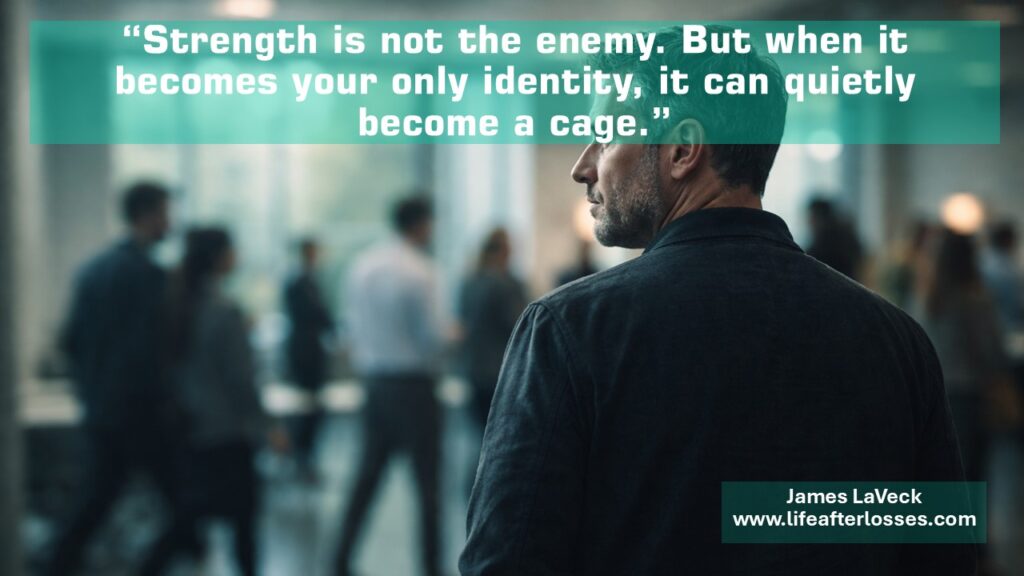
Strength is not the enemy.
But when it becomes your only identity, it can quietly become a cage.
You are allowed to be resilient and unsure. Capable and overwhelmed. Grounded and still growing.
Maybe renewed purpose isn’t about becoming stronger.
Maybe it’s about becoming more whole.
And wholeness includes the parts of you that don’t want to be strong all the time.
That might be worth considering, don’t you think?