At some point, usually without anyone saying it directly, there’s an expectation that starts to take hold from others and yourself: you should have things figured out by now. Not every detail, but enough that your life makes sense to you and to the people around you. Enough that if someone asks what you’re doing or where you’re headed, you can answer without hesitation.
And when that answer isn’t there, it creates some panicked pressure.
It shows up in moments that don’t seem like much on the surface. A simple question about what’s next. A conversation where everyone else sounds certain. And when you pause briefly before you respond, that’s when you realize you don’t have a clean way to explain where you are. So you say something that sounds close enough. Something that technically fits, even if it doesn’t fully capture the truth of it.
Because “I don’t know” can feel like an incomplete answer.
It can feel like you’re supposed to be further along than you are. Like not knowing means you’ve missed something, or that you’re behind in a way you can’t quite explain. And most of us don’t like sitting in that space for very long, so we try to move out of it as quickly as possible.
We look for clarity. We try to define things. We make decisions sooner than we might need to, just so we can replace uncertainty with something more solid.
The assumption underneath all of that is simple: knowing means you’re making progress. Not knowing means you’re stuck.
But that assumption doesn’t always hold up.
There are times when nothing is wrong, and the lack of a clear answer isn’t a sign of failure or confusion. It’s just a sign that something hasn’t fully taken shape yet. You’re not missing it. It’s still forming.
It matters to make that distinction because it changes how you respond to that feeling.
If you treat uncertainty like a problem, your instinct will be to solve it as quickly as possible. You’ll reach for an answer, even if it’s not fully developed, just to relieve the discomfort of not knowing. And sometimes that works. But sometimes it leads you to define something before you’ve actually had the chance to understand it.
I’ve done that more than once—moved too quickly to put a label on something, to give it direction, to make it make sense. And what I’ve learned is that premature clarity can feel satisfying in the moment, but it doesn’t always hold up over time.
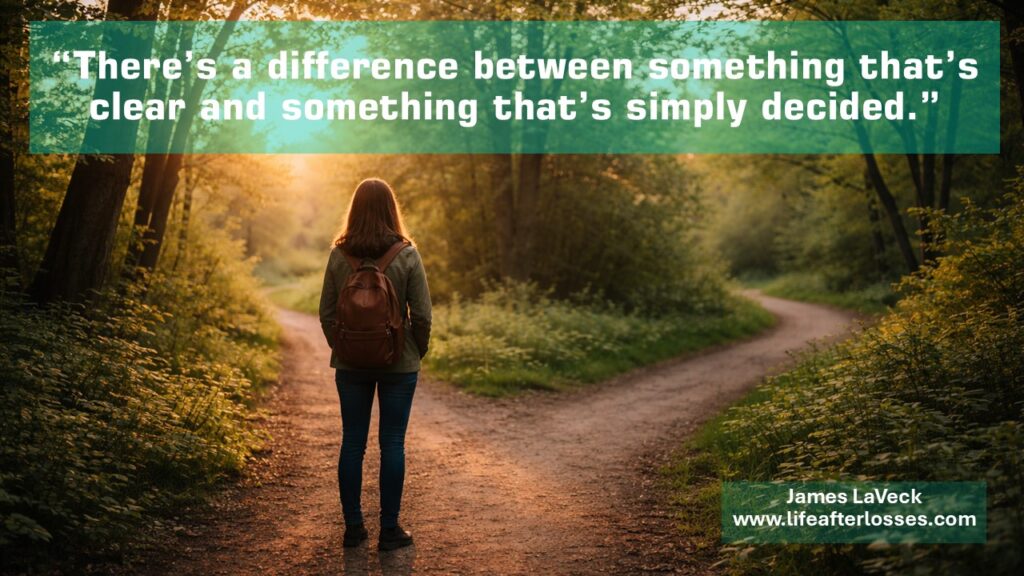
There’s a difference between something that’s clear and something that’s simply decided.
What I’ve become more comfortable with over time is recognizing when something isn’t ready to be defined yet. Not avoiding it, not ignoring it, but giving it space to develop without forcing it into a conclusion too early.
That doesn’t mean doing nothing. It means continuing to live your life in the areas that are already clear while allowing other parts to remain open. It means paying attention to what’s unfolding instead of trying to finalize it before it’s ready.
And that’s where things change.
Because when you stop treating uncertainty as something you need to eliminate, it starts to feel different. Less like a gap you need to fill, and more like a space that has potential in it. A space where something can take shape in a way that actually fits, instead of something you decided just to move forward.
That space isn’t always comfortable. There’s no clear timeline, no guarantee of when things will come together, and no immediate sense of resolution. But there is room in it—room to notice, to experience, to understand something more fully before you define it.
And in a strange way, that can be freeing.
Not because everything is open-ended forever, but because you’re no longer forcing yourself to have answers you don’t actually have yet. You’re allowing your life to move at a more natural pace, where some things are clear and others are still developing.
Both can exist at the same time.
And when you start to see it that way, not knowing stops feeling like something you need to fix.
It just becomes part of how things unfold.
Your Turn
Think about an area of your life where you feel pressure to have a clear answer right now. Something you believe you should have figured out by this point.
Instead of trying to resolve it immediately, take a step back and look at it differently.
Is it possible that nothing is wrong?
That the answer simply hasn’t taken shape yet?
And if that’s the case, what would it look like to give it a little more space—without rushing to define it before it’s ready?