If you’ve followed along for a while, you know part of my trigger-avoidance practice is this: think ahead about how you want a triggering day to go, and take a measure of control over it.
Confidence comes from preparation, and being prepared usually means you’ve put in the time to understand what you’re walking into.
You study. You practice. You think through how something might go, and you think of the variable responses you’ll have. You try to get a sense of what’s expected so you’re not caught off guard when the moment comes.
That kind of confidence matters. It gives you something to stand on when you step into something new.
But there’s another kind of confidence that only comes from experience, and it doesn’t show up the same way.
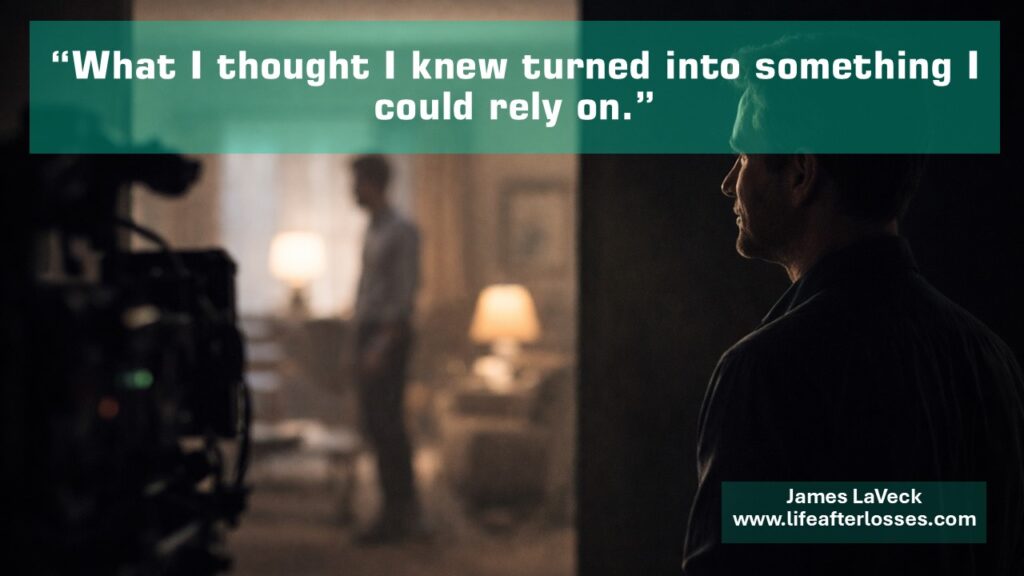
For example, the first time I stepped in front of the camera to deliver a performance, I was nervous. I knew my lines, and I had a clear idea of how I wanted to deliver them. In my head, it all made sense. I had a version of the scene that I felt ready to execute.
Then I got into it with my scene partner.
As we started working through the scene, I could feel things changing. Their intensity, their pacing, the way they delivered their lines—it all affected what was happening in the moment. And without really planning to, I started adjusting, and matching.
What I thought I was going to do wasn’t what I ended up doing.
Here’s the thing… I wasn’t abandoning the work I had done. I was building on it. Responding to what was actually happening in real time instead of trying to hold onto what I had imagined ahead of time.
That was the moment it clicked for me.
Knowing my lines and understanding the character helped me get there. But being in the scene—reacting, adjusting, staying present with another person—that’s where it became real.
What I thought I knew turned into something I could rely on.
That experience taught me something important.
The next time I stepped in front of the camera, I was still prepared. I still knew my lines. I still had a sense of the scene and my character.
But I approached it differently.
I wasn’t trying to control how everything would go. I trusted that once I was in it, I’d be able to respond to whatever was in front of me. I didn’t need to have every moment figured out ahead of time because I had already been through the experience of adapting in real time.
That changed how I showed up—not just as an actor, but in how I approached the work.
Over time, that kind of experience changes how you deal with uncertainty.
You stop needing everything to go exactly as planned. You stop relying on a perfect setup before you begin. You start to trust that you’ll be able to handle what happens, even if it’s not what you expected.
That kind of confidence isn’t something you have to shout from the rooftops.
Instead, it shows up in how you move through things. In the way you stay steady when something doesn’t go according to plan. In the way you adjust without overthinking it. In the way you don’t feel the same pressure to prove that you know what you’re doing.
Because you’ve already been in situations where you didn’t know—and you figured it out anyway.
That’s the part that builds over time.
Not just what you know, but how you handle what you don’t. And let’s face it, we all know way less than we know, so we need to learn how to handle what we don’t know.
And the more you experience that, the less you need to rely on certainty to feel confident moving forward.
I’m reminded of when I started my career as a consultant. The SVP who greeted all the new hires made a comment that speaks to flexibility and our adaptability by telling us to “be a Gumby.”
That bendable green toy sits prominently on my desk, as a reminder to be prepared, but flexible enough to adjust when needed. Over the years, I’ve learned that between preparedness and flexibility, life can be pretty good.
Your Turn
Think about a situation in your life where you feel pressure to have everything figured out before you begin.
Now take a step back and look at your past experiences.
Where have you handled something in real time, even when it didn’t go as expected? Did you insist on rigidity, or did you allow some flexibility?
What did that teach you about how you show up in those moments?
And how might that change the way you approach what’s in front of you now?