One of the things nobody really talks about is how strange it can feel when life starts feeling good again.
People expect grief to be painful. They expect sadness, loneliness, tears. They expect the hard days, the anniversaries, the moments that knock the wind out of you when you least expect it. That part makes sense to people. That part fits the story they already have in their heads about what grief looks like.
What catches a lot of people completely off guard is what happens when those moments start becoming less frequent. When you laugh without thinking about it first. When you realize, somewhere in the middle of an ordinary afternoon, that you’ve actually had a good day. When you catch yourself looking forward to something again.
Because sometimes those moments arrive with an unexpected companion: guilt. At least they did for me.
A few years after Bob died, there came a point where I started dating again. Even saying that out loud feels strange all these years later, because I remember how complicated it felt at the time. Part of me wanted companionship. Part of me missed connection. Part of me understood, on some level, that I was still alive and that life was still moving whether I was ready for it to or not. But another part of me felt like I was cheating.
Not intellectually — I could reason my way through it clearly enough. Emotionally, though… Well, it felt completely different. It felt like allowing someone else into my life somehow diminished what Bob and I had shared. Like opening the door to something new meant closing the door on something that deserved to stay open forever. Like joy, somehow, was a form of forgetting.
Looking back now, I can see how grief twists those ideas together in ways that feel completely real while you’re inside them. Love and replacement are not the same thing. Memory and loyalty are not the same thing. But when you’re standing in the middle of loss, those distinctions aren’t always easy to hold onto.
Years later, after my second loss, I found myself facing a different version of the same question. By then, more than a decade had passed. I wasn’t making any declarations or trying to map out what the rest of my life was supposed to look like. But I did make a promise to myself, and others, that I would at least remain open to the possibility.
Not because I was lonely, and not because I needed someone to complete my life. But because I looked ahead and realized I might have another twenty or thirty years in front of me. And I wasn’t willing to decide, on behalf of a future version of myself, that love would never be part of that picture again. That wasn’t a declaration. It was permission. Permission to believe my life wasn’t over. Permission to believe that something meaningful could still exist on the other side of loss.
And then something unexpected happened. Last year, I met someone who made me realize that possibility wasn’t just a theory I’d been holding onto to get through the day. It was real. It wasn’t dramatic, and it certainly didn’t resolve every complicated feeling I’d been carrying, or even the complicated feelings I still have. What surprised me most was the realization itself — quiet and sudden at the same time.
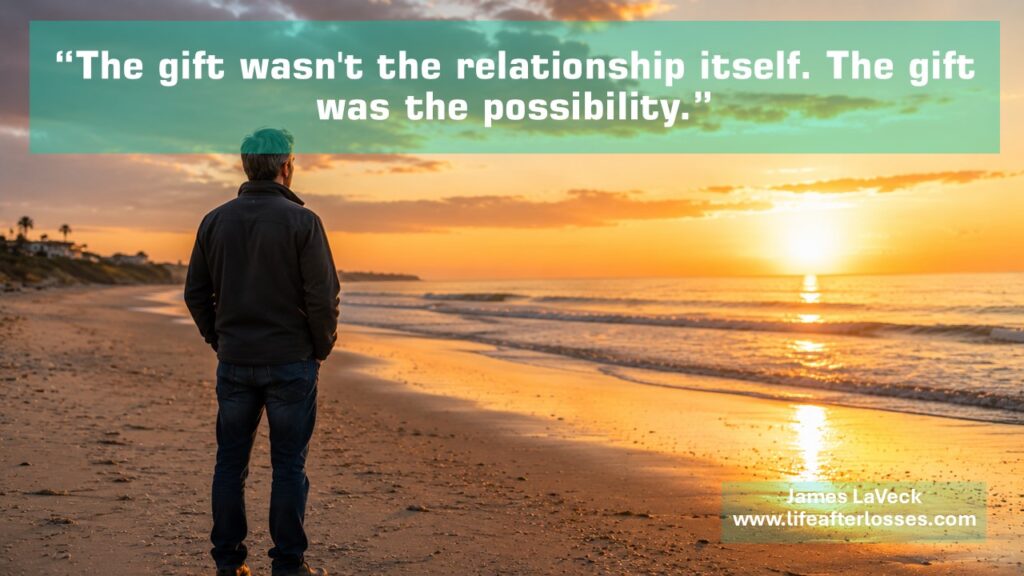
I discovered that I could still feel genuine excitement. That I could still feel real connection. That I could still imagine sharing my life with someone without feeling like I was betraying everything that came before. And that realization mattered far more to me than any specific outcome, because the gift wasn’t the relationship itself. The gift was the possibility. The proof that something in me was still open, still alive, still capable of hoping.
I think that’s what a lot of people struggle with after loss. Eventually, grief becomes so familiar that possibility starts to feel foreign. You get accustomed to carrying the weight, you learn how to survive inside it, you adapt to what is. But imagining what could be? Well, that’s a completely different challenge.
Because here’s the thing: possibility requires hope, and hope requires a kind of vulnerability that can feel almost dangerous after you’ve already lost so much. It requires believing, even just a little, that life may still hold experiences you haven’t had yet. That there are still chapters you haven’t read.
Sometimes we worry that feeling good means we’ve forgotten. That happiness is somehow a measure of how far we’ve moved away from the people we loved. That joy is a kind of betrayal dressed up in nicer clothes. But I’ve come to believe the opposite. The return of happiness doesn’t diminish the love. The return of hope doesn’t erase the grief. It simply means that life is still growing — that your story is still being written, and that your capacity for connection, meaning, and love did not disappear alongside the loss, even when it felt, for a long time, like maybe it had.
Life feeling good again isn’t a betrayal of your loss or grief. It’s a reminder. A reminder that grief may become part of your story, a real and significant part, but it doesn’t have to be the final chapter.
Your Turn
This week, I’d like you to think about the following:
Is there something in your life you’ve pretty much decided is no longer available to you? A dream, a relationship, a goal, a version of yourself you’ve already written off?
What if that assumption deserves another look? And, what would change — even just a little — if you gave yourself permission to believe that something good might still be ahead?