There are certain things we just expect when we’re young.
We expect to be beginners. We expect not to know what we’re doing. We expect to make mistakes and learn as we go. Nobody looks at a teenager learning to drive and thinks, “Well, they really should have this figured out by now,” despite how many hours they’ve logged on driving games. Being inexperienced is just part of the deal when you’re young. It’s assumed. It’s allowed.
But something interesting happens as we get older.
We spend years building careers, raising families, solving problems, and becoming genuinely capable in all sorts of ways. We develop expertise. We gain confidence. We figure things out. And without even realizing it, we start building lives where being a beginner becomes entirely optional. We gradually arrange things so that we mostly operate inside the territory we already know.
That’s not necessarily a bad thing; there’s something deeply satisfying about competence. It’s nice to walk into situations feeling prepared instead of overwhelmed. It’s nice to have enough experience that you can handle most of what life throws at you without completely falling apart. But competence can become so comfortable that we stop putting ourselves in situations where we don’t already know the answers. And that’s where things get interesting.
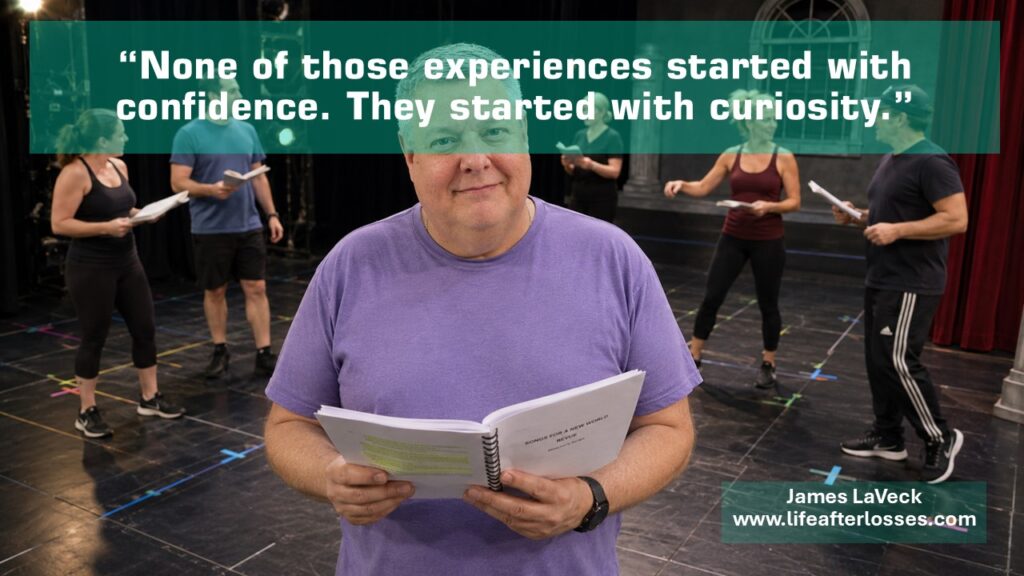
A few years ago, I joined a musical revue with a local theater group. At first, it sounded like fun. Something different. Something outside my normal routine. I’d never done anything like it before, which honestly seemed like part of the appeal.
And then rehearsals started.
Suddenly, I wasn’t just learning a few songs. I was learning choreography. I was learning staging. I was learning how to move while singing — which, I can tell you from personal experience, is significantly harder than it sounds. I was learning how to remember where I was supposed to be, how to tell a story through a performance, and how to do all of it in front of an actual audience. And if I’m being completely honest, there were moments during those rehearsals where I genuinely wondered what I had gotten myself into. Like, deeply wondered.
It’s one thing to try something new. It’s another thing entirely to discover that you are not immediately good at it. And I was not immediately good at it.
I think that’s the part nobody really talks about. When we’re younger, being a beginner doesn’t bother us much because it’s expected — it’s the whole point. When we’re older, being a beginner can feel surprisingly uncomfortable, because we’re so used to being competent. We’re used to knowing. We’re used to having answers. We’re used to understanding the rules of whatever room we’re in. Being a beginner means stepping into a room where none of that applies, and you just have to be okay with that for a while.
For me, the hardest part of that whole experience wasn’t learning the songs. It wasn’t even the choreography (though, if you were to ask anyone who was there, I definitely struggled).
No, the hardest part was being willing to be bad at something long enough to eventually get better at it.
That required a different kind of confidence than I was used to. Not the confidence that comes from knowing, but the confidence that comes from learning. The kind that says, I don’t know how to do this yet, but I’m going to keep showing up anyway.
And here’s what I think happens to a lot of people as they get older. It’s not that they’re incapable of learning new things. It’s that they’ve spent decades building an identity around being competent, and starting over threatens that identity. Being a beginner means making mistakes in front of other people. It means asking questions that feel like they should be obvious. It means looking awkward and uncertain in situations where you’d much rather look like you know what you’re doing.
So people stop trying. Not out of laziness, but out of self-protection.
Here’s the thing… some of the most meaningful experiences of my life have come from exactly those uncomfortable situations. Writing my first book. Stepping back in front of a camera after nearly three decades. Learning entirely new skills and meeting people I never would have crossed paths with otherwise. None of those experiences started with confidence. They started with curiosity, which, it turns out, is enough to get you through the door. The confidence tends to show up later, once you’ve already committed to being there.
I don’t remember every mistake I made during that revue. I don’t remember every step I got wrong or every rehearsal where I felt completely behind. What I remember is the experience itself: the growth, the friendships, the genuine satisfaction of doing something that felt impossible when I started. That’s the thing about being a beginner. You only get to be one for a little while. Eventually, you learn. Eventually, you improve. Eventually, you become the person who knows what they’re doing. But to get there, you have to be willing to first be the person who absolutely does not.
And that’s true whether you’re learning choreography, writing a book, dating after loss, changing careers, or pursuing something you’ve been quietly putting off for years. Every meaningful chapter starts with someone who doesn’t know what they’re doing yet. The question is just whether we’re willing to be that person again.
Your Turn
This week, I’d like to invite you to reflect on something you’ve been interested in trying but haven’t pursued. What’s actually stopping you? Is it the thing itself, or is it the idea of being a beginner? What might become possible if you gave yourself permission to be inexperienced for a while? And what might you find on the other side of that learning curve?
Look, I try to take every day as an opportunity to learn something new. For me, it keeps life fresh. It reminds me there’s still more to discover. What about you?