You know that moment when you’re mindlessly scrolling through your phone, maybe procrastinating on something important, and then BAM—there it is. Another anniversary post. Another “45 years and counting!” celebration. Another couple beaming at the camera, weathered hands intertwined, eyes that still crinkle with shared secrets from decades of inside jokes.
And look, I’m genuinely happy for them. I am. There’s something beautiful about witnessing love that’s managed to outlast receding hairlines and reading glasses, that’s survived mortgage payments and teenager drama and whatever the hell 2020 threw at all of us.
But sometimes—and this is the part I hesitate to admit—it also feels like a gentle knife twisting in my chest. Because when I see those milestones, my brain does this thing where it immediately starts calculating, like some morbid math problem I never asked to solve.
If I’m being optimistic about my remaining time on this planet, maybe I’ve got another 20 or 25 years left. And when I tally up what I did have—22 beautiful, complicated, absolutely worth-it years across two great loves—the numbers tell a story I’m still learning to accept. My shot at growing old with someone? At celebrating our own weathered-hands anniversary? That ship has sailed, and I’m still standing on the dock, watching it disappear into the horizon.
God, even typing that makes my throat tight.
The Comparison Trap (and Why It’s Sneakier Than You Think)
Here’s what I’ve learned about grief: comparing pain is pointless. Your heartbreak isn’t a competition with anyone else’s. Your healing timeline doesn’t need to match what worked for your cousin’s friend’s sister who “bounced back so quickly” after her divorce.
But comparing outcomes? That’s the sneaky one. That’s the 2 AM scroll-through-Instagram kind of comparison that leaves you staring at the ceiling, wondering what your life would look like right now if they were still here to argue with you about the thermostat setting.
It’s not about wanting what someone else has, exactly. It’s about mourning the future you thought was yours. The one where you’d complain about each other’s snoring for the next three decades. The one where you’d perfect your eye-roll technique every time they told the same story at dinner parties. The one where you’d grow into those couples who finish each other’s sentences not because it’s romantic, but because you’ve literally heard it all before.
That’s what I’m grieving, if I’m being honest. Not just what was, but what will never be.
The Futures We Mourn
We talk a lot about grieving what we’ve lost. But I think we don’t talk enough about grieving what we’ll never have the chance to lose. The anniversary trips that exist only in the alternate universe where cancer didn’t win. The retirement years we’d spend bickering about which Netflix show to watch next. The decades of accumulated inside jokes that would have made absolutely no sense to anyone else.
I had this vision once—probably during one of those half-awake moments when your brain gets all sentimental—of us as that elderly couple shuffling through a store, debating whether we really needed another throw pillow. Such a mundane little fantasy, but it felt so real, so possible, that losing it almost hurts more than losing what we actually had.
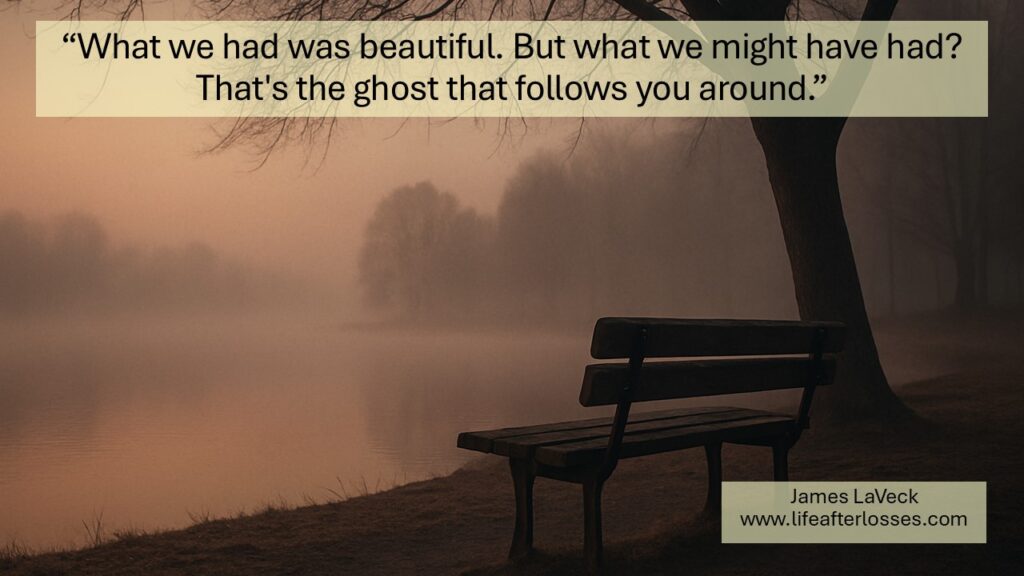
Because what we had was beautiful. But what we might have had? That’s the ghost that follows you around, whispering about all the ordinary moments that would have been extraordinary simply because they happened together.
What We Do With the Time We Have (When It’s Not What We Planned)
So here’s my current existential crisis: If I get another 20 years—and that’s a generous estimate, considering my caffeine intake and tendency to ignore expiration dates—what am I supposed to do with them?
They won’t look like what I pictured. There won’t be matching rocking chairs or arguments about whose turn it is to take out the trash. There won’t be someone to remember my coffee order or to text me ridiculous memes at inappropriate times during work meetings.
But maybe that’s not the point. Maybe the point is figuring out what kind of meaningful can exist in this unplanned-for life. Maybe it’s about building something beautiful from the pieces you have left, even if it looks nothing like the original blueprint.
Letting go of what could’ve been isn’t about pretending you never wanted it. It’s about holding space for the grief of that lost future while also making room for whatever wants to grow in its place. It’s about saying, “This isn’t the life I ordered, but it’s the one I’m living, and I’m going to find a way to make it count.”
Maybe that means friendships that become your chosen family. Maybe it’s creative work that gives your days new shape and purpose. Maybe it’s moments of unexpected peace that sneak up on you when you’re least expecting them—like when you’re watching the sunset and suddenly remember that you’re still here, still breathing, still capable of being amazed by the way light hits the clouds.
A Different Kind of Milestone
I’m starting to think that maybe the milestone isn’t a date on a calendar. Maybe it’s not about how many years you can rack up with one person. Maybe it’s about how many times you can choose to show up for the life you actually have instead of the one you thought you were supposed to get.
Maybe it’s about releasing the timeline you thought you needed in order to feel whole. Maybe it’s about saying, “This is enough. This messy, unplanned, sometimes-lonely-but-also-surprisingly-full life is enough. And I’m still here.”
Because healing isn’t about catching up to where you thought you’d be by now. It’s about showing up—for the Tuesday morning coffee that tastes better than it should, for the friend who texts you terrible jokes, for the quiet moments when you realize you’re actually okay, even when okay wasn’t what you were aiming for.
So today, if the what-could’ve-beens start creeping in like uninvited guests, take a moment. Breathe. Feel it. Let it be real and valid and heartbreaking. And then ask yourself: What’s still possible from here? What new kind of beautiful might be waiting to be discovered?
I’d love for you to think about this: what new milestones are you creating for yourself—big or small? What does “enough” look like in your unplanned-for life?