We’ve been talking about survival and what it means when it’s no longer the focus or the goal of the day, and there’s a strange moment that happens after that point.
Not during the crisis.
Not during the rebuilding.
After.
When things are finally stable enough that the question changes.
We’ve talked about this: for a long time, the goal was simple:
Get through the day.
Keep moving.
Hold things together.
And for a while, that was more than enough. Sometimes, it was all that mattered.
But eventually… something starts to shift.
You’re no longer in free fall.
You’re no longer reacting to every impact.
You’ve regained your footing.
And that’s when a different kind of question starts to surface.
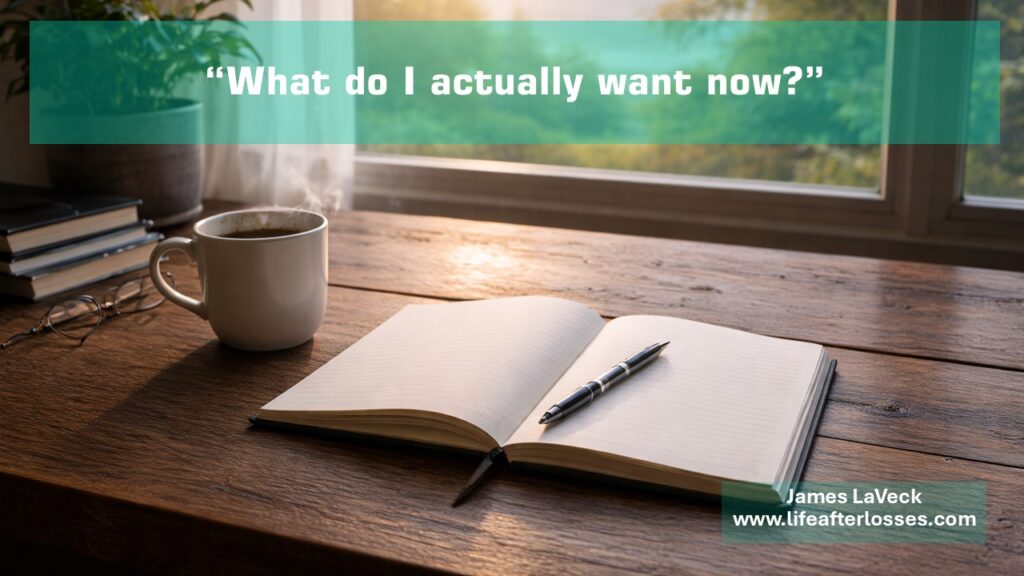
Not “How do I survive this?” But something much harder: What do I actually want now?
That question can feel surprisingly uncomfortable under any circumstances because we’re not conditioned to want for ourselves, and it feels magnified when dealing with loss or transition.
When we’re focused on survival mode for a long time, desire hides in the background.
You stop asking what you want.
You stop imagining possibilities.
You stop making choices based on curiosity or ambition.
Instead, you prioritize stability.
Functioning becomes the win.
And there’s nothing wrong with that. Stability matters. Recovery matters. Endurance matters.
But eventually stability creates space to start asking that question many of us aren’t prepared for: What do I actually want now?
When life has been organized around survival, we stop practicing the skill of wanting.
We make decisions based on safety instead of possibility. We focus on maintaining what we rebuilt instead of imagining what might come next.
That’s totally understandable. After loss or upheaval, stability feels like an achievement.
But stability was never meant to be the final destination.
If survival is no longer the only goal… what is?
For some people, the first answer is silence.
Because desire has been dormant for a long time.
For me, it became a “back-burner” item. It was there, just ignored. And, if I’m being perfectly honest, sometimes shunned.
It took me several years to start thinking about what was next. And it was uncomfortable, to be sure. Writing my books began as a therapeutic step. But as I stepped back and looked at my life and where I was, I realized I had been doing the work all along, just not as intentionally as I could have. That realization eventually became the impetus for Grief Recovery for Adults.
When your energy has been focused on surviving loss, navigating grief, rebuilding identity, or stabilizing your life, the idea of wanting something new can feel foreign.
Sometimes it even feels selfish. How dare you want something after losing everything!
Sometimes it feels risky.
Sometimes it feels like you’re betraying the version of yourself that fought so hard just to endure.
But wanting something again is evidence that survival worked. It isn’t a betrayal of survival.
Desire is a sign of life expanding again.
It’s the moment when your focus begins to move from endurance toward intention.
And I get it: that transition can feel uncertain.
You may not know exactly what you want.
You may not have a clear vision.
You may only have a feeling that the life you rebuilt was designed for stability… not necessarily for fulfillment.
Being aware of that difference gives us the opportunity to explore new directions, whether we know where they lead or not.
Desire doesn’t always show up as a clear goal.
Sometimes it appears as restlessness.
Sometimes it appears as curiosity.
Sometimes it appears as a quiet sense that something more is possible.
That doesn’t mean you need to rush toward answers.
It simply means you’re allowed to start asking different questions.
Not just: “How do I keep going?”
But:
“What would make this life feel meaningful again?”
“What would bring energy back into my days?”
“What would I pursue if I wasn’t only focused on maintaining stability?”
Survival keeps us alive, and these questions aren’t recklessly tossed out. They’re responsible.
Because desire helps us decide what we want to do with the life we fought to keep — the life we survived for.
So here’s what I’ve been thinking about recently, and I’ll offer this reflection to you as well.
Not as pressure or expectation.
Just as a place to begin.
I want you to think about this over the next several days or so:
If survival is no longer the only goal…
What do you want now?
You don’t need a perfect answer.
You just need the courage to let the question exist.
That’s often the first real step toward renewed purpose.
If you’re looking for additional support, check out Grief Recovery for Adults.