Can I tell you something I’ve been thinking about a lot lately?
I’m not sure most of us were ever given an honest definition of happiness.
We were given a marketable one. A polished one. A version built around achievement, appearance, status, and the idea that if you just keep moving upward — keep hitting the next milestone, keep climbing — eventually you’ll arrive at a life that feels good enough to stay in.
That’s the version most of us inherited.
A good job. A certain income. The right relationship. The right house. A life that looks successful from the outside and, hopefully, feels successful on the inside too.
And look… there’s nothing wrong with wanting good things for your life. I’m not against ambition. I’m not against building something meaningful or wanting more than you started with. But I think a lot of people unexpectedly discover something they weren’t prepared for.
You can achieve things and still feel completely disconnected from yourself.
You can build a life that looks right and still feel friction inside it every single day.
And when that happens, most people assume the answer is more. More progress. More success. More productivity. More validation. More something.
But I’m not sure happiness works that way.
The older I get, and the more life I actually live, the more I think happiness has a lot to do with truth.
Truth about what matters to you now — not what mattered five years ago, not what you thought would matter by this point. Truth about what drains you and what restores you. Truth about whether the life you’re building actually feels like yours.
Because when we’re out of alignment with those truths, there’s friction. And you feel it. Sometimes quietly. Sometimes constantly.
You wake up tired even when you’ve slept. You accomplish things that don’t actually satisfy you. You keep performing versions of yourself that stopped fitting a long time ago.
And after a while, that disconnect catches up with people.
I think grief has a way of exposing this faster than almost anything else.
When you lose someone you love — or when life changes in ways you never asked for — a lot of the performance starts falling away. Things get more honest. Sometimes painfully honest. You stop assuming time is unlimited. You stop believing that appearances tell the whole story. You start asking different questions.
At least, I did.
Questions like: What actually matters to me now? What feels sustainable? What leaves me feeling restored instead of empty? What parts of my life feel true, and what parts feel like a role I’m still playing out of habit?
Those questions changed me. And honestly, they’re a big part of why I started exploring happiness more intentionally — through my coaching work and through the free Come On, Get Happy! workbook. Because I needed a better framework than the one I’d been handed.
Not because I think happiness means feeling good all the time. It doesn’t. Anyone who has lived through grief, loss, anxiety, heartbreak, caregiving, or just the weight of real life knows that.
Happiness isn’t the absence of hard emotions. It’s not relentless or toxic positivity. And it’s definitely not pretending everything is okay when it isn’t.
If anything, I think real happiness becomes more possible when we stop fighting reality long enough to be honest about it.
There’s actually a growing body of research on well-being that points in this direction. People tend to experience deeper, more lasting well-being when their lives feel aligned with their values, their relationships, their sense of purpose — not just pleasure or achievement alone. That makes a lot of sense to me.
Because some of the happiest moments in life don’t look impressive from the outside at all.
A real conversation. A quiet morning. Laughing harder than you expected to. Doing work that actually feels meaningful. Feeling comfortable enough to tell the truth about where you are.
Those moments don’t photograph well for easy social media consumption. But they feel real while you’re living them. And I think that matters more than we admit.
I also think happiness may be closer to our natural state than we realize. I’m not talking about permanent happiness or nonstop joy (as if that were possible). But a basic sense of openness and aliveness that gets buried under stress, performance, grief, exhaustion, and the pressure to become someone we were never really meant to be.
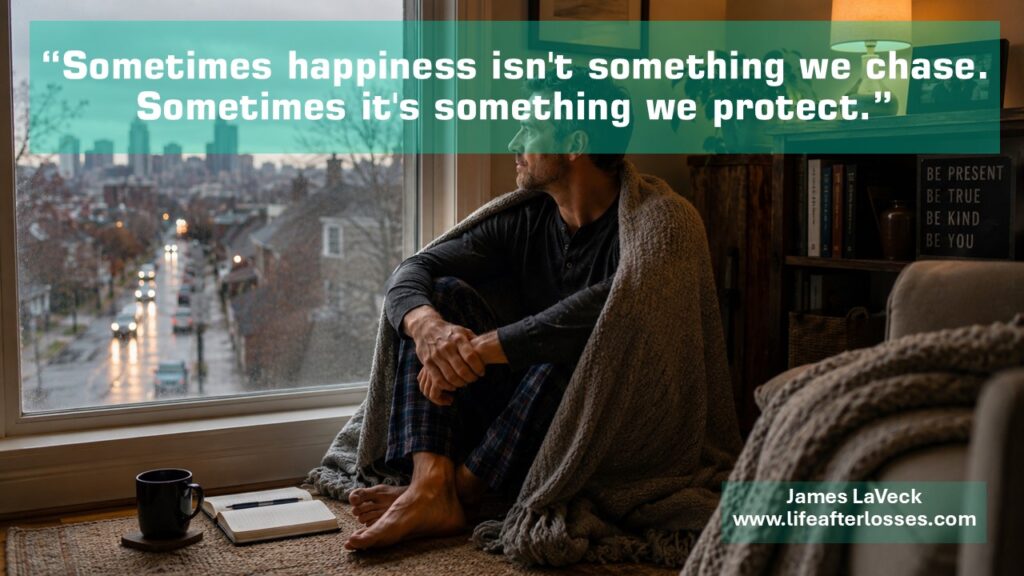
Which means sometimes happiness isn’t something we chase.
Sometimes it’s something we protect.
Protect from constant depletion. Protect from noise. Protect from pretending. Protect from building a life that looks right on the outside but feels wrong when you’re actually living inside it.
This is where I find myself: protecting my moments of happiness when various parts of my world appear to be collapsing all around me.
I think that changes the whole conversation. Because now happiness isn’t about winning some impossible game. It’s about becoming honest enough to build a life you can actually breathe inside.
And maybe that’s a better definition than the one most of us started with.
Your turn
This week, I’d like you to ponder this question: When do you feel most like yourself? Not most impressive. Not most productive. Most yourself.
What parts of your life feel honest and real right now? What parts feel performative or disconnected?
And if happiness has more to do with truth than appearances — what truth in your life might deserve a little more attention?