I used to think happiness was supposed to feel bigger than it actually does.
Bigger. Louder. More obvious.
Like someday you’d arrive at this version of your life where everything finally clicks into place and you just… stay there. Permanently. Consistently happy. Like you’d unlocked something everyone else was still trying to reach.
I think a lot of us grow up carrying that idea. That happiness is a destination. A reward that’s waiting for us once enough things go right.
And maybe that’s part of why so many people feel like they’re failing at it.
Because real life doesn’t work that way. Even during genuinely good seasons, difficult things still happen. Stress still exists. People still get sick. Loss still changes us. There are still bills, responsibilities, and days where your energy is just gone. So if happiness is supposed to mean the absence of all that — most of us are going to spend our whole lives feeling like we somehow missed it.
But joy feels different to me.
Joy doesn’t seem to care much whether life is perfect. It doesn’t wait for everything to be resolved. It just shows up — in moments, unexpectedly, in the middle of an otherwise ordinary day.
My dog greeting me at the door like I’ve been gone for ten years instead of two hours. Sitting with friends at trivia night, laughing harder than the situation probably warrants. Finding a new song that hits in exactly the right place emotionally. Warm spring air after a long winter. Standing near clear blue water at a beach and feeling my nervous system finally — finally — unclench a little. Getting pulled completely into a concert or a musical for a few hours and forgetting, just for that stretch of time, that there’s anything else to worry about.
Those moments don’t erase the hard parts of life. They don’t fix anything.
But they matter anyway. And I think that distinction is worth sitting with.
Because happiness — at least the way a lot of us were taught to think about it — can start to feel like a permanent emotional state we’re supposed to achieve and then maintain. Something you either have or you don’t.
Joy feels more human than that, to me. More available. More connected to presence than to perfection.
One of the stranger things I’ve noticed over the years is that sometimes we don’t even recognize happiness while we’re living inside it. We only recognize it later, once enough has changed to give us some perspective.
There are moments I look back on now that felt completely ordinary at the time. Simple conversations. Everyday routines. Certain people. Certain seasons of life. Nothing about them announced itself as important while it was happening.
And yet — after loss, after change, after enough time passing — I found myself looking back thinking, that was actually a really beautiful part of my life. I just didn’t fully know it yet.
I think part of understanding joy comes from contrast.
You understand rest differently once you’ve been truly exhausted. You understand peace differently once life has been chaotic. You understand connection differently once you’ve experienced real loneliness. And after grief enters your life, you become aware in a very different way that moments are temporary — which can actually make them feel more meaningful, not less.
That’s been true for me, anyway.
And I don’t think that awareness is meant to make us anxious or constantly nostalgic — always bracing for the moment something good ends. I think it’s more about learning to be present enough to actually notice life while we’re living it.
Not every second. Not perfectly. Just more often than we usually do.
To notice when something feels good instead of rushing straight to the next thing. To let yourself laugh without mentally stepping outside the moment to analyze it. To enjoy being with someone without needing to document it. To hear a song that moves you and just … stay there with it for a minute.
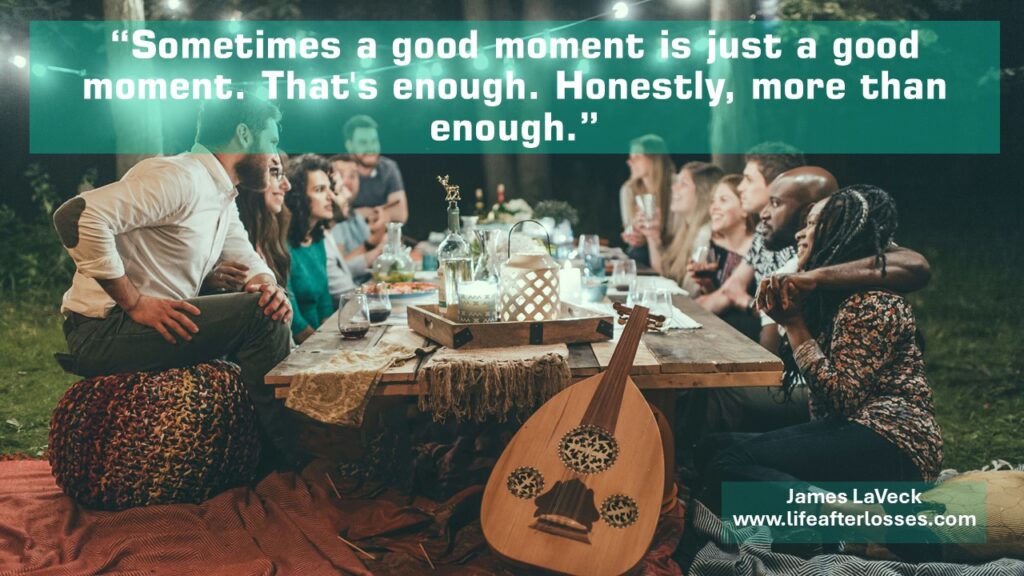
I also think joy gets easier to recognize once we stop demanding that every good feeling solve our entire life. Sometimes a good moment is just a good moment. That’s enough. Honestly, more than enough.
Maybe happiness was never really the finish line we were taught to chase. Maybe it’s something quieter than that — built from smaller moments of aliveness, connection, presence, laughter, music, friendship, creativity, and love that show up along the way.
Not constantly. Not perfectly. But genuinely.
And maybe part of living fully after loss is simply this: allowing yourself to realize that joy still belongs to you, too.
Your turn
What moments in your life bring you genuine joy right now? Not what looks impressive. Not what you think should make you happy. What actually makes you feel more alive when you’re in it?
And looking back — are there moments that seemed completely ordinary at the time, but feel much more meaningful now?