A few weeks ago I wrote about a conversation I’d had with a younger friend — a musician — where I found myself telling him something I’ve had to learn in my own life: that perfection can become the enemy of progress, and that waiting until you’re completely certain you’re ready is sometimes just another way of not starting.
That conversation became Entry 294.
After it was published, he sent me a message. Just a few words: “I really like what you wrote. Let’s grab a meal and talk about life.”
We haven’t had that meal yet. But I’ve thought about that message quite a bit since it arrived.
There was something in those few words I hadn’t really considered when we’d had the original conversation. I’d been thinking about what I could learn from spending time with people younger than me — their perspective, their experiences, the music and ideas and ways of looking at the world they introduce me to that might not otherwise cross my path. I’ve always liked that kind of exchange.
What I hadn’t really considered was what might be traveling in the other direction.
I’m not sure “mentor” is the right word for what’s happening between us. It feels a little too formal, a little too deliberate. I’m certainly not sitting across from him with a notebook and a lesson plan. We’re just talking. But somewhere in those conversations, the experiences I’ve accumulated over nearly sixty years have started becoming useful to someone else, and it’s not about grief and recovery. And that’s been interesting to sit with.
I’ve spent a lot of time over the years thinking about what loss takes from us. That’s understandable — loss changes relationships, plans, identities. Sometimes it takes away a future we’d already begun imagining. And when that happens, questions about purpose can get genuinely complicated. What gets me out of bed now? Who needs me? What am I working toward? What matters enough to keep showing up for?
Those questions aren’t unique to grief after a death, either. They show up after a divorce, a retirement, a career change, an empty nest, an illness, the end of a friendship — any experience that leaves us looking at a life that no longer works quite the way it used to.
For most of my life, I think I understood purpose as something we were supposed to find. Almost like it was out there somewhere, waiting. Maybe if we chose the right career, met the right person, created something important, or found some larger mission, we’d eventually be able to point at it and say — there. That’s it. That’s my purpose.
I’m not sure I believe that anymore.
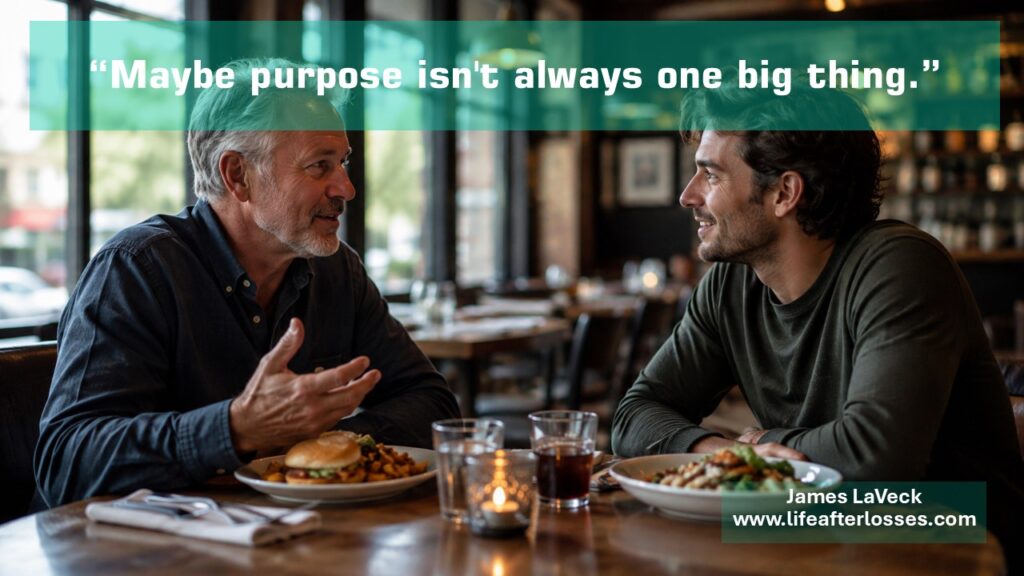
Maybe purpose isn’t always one big thing. Maybe sometimes it’s simply discovering that the life we’ve already lived has given us something worth bringing into the life we’re living now.
That thought has been following me since my friend’s message arrived. My losses are part of what I bring to those conversations. So are the relationships I’ve had, the careers I’ve pursued, the mistakes I’ve made, the risks I’ve taken, the people I’ve loved, the things I’ve gotten right, and plenty of things I haven’t. None of those experiences exist separately anymore. They’ve all bundled together into something called perspective.
And perspective is a strange thing, because you rarely notice yourself acquiring it. There was no morning I woke up and thought, “Excellent. I have perspective now.” Mostly I just kept living. I made decisions — some worked, some didn’t. I loved people. I lost people. I changed careers. I raised children. I wrote books. I tried things that scared me and abandoned other things that stopped fitting. I learned lessons I probably could have learned more easily if I’d listened the first time around.
Eventually, all of that became the person sitting across the table from someone younger, saying “you know, perfection might be getting in your way.” And apparently, that was useful.
There’s something unexpectedly meaningful about that. Especially because I wasn’t looking for it. I wasn’t trying to become his mentor. I wasn’t trying to turn a friendship into some larger mission. I was just showing up as myself.
Maybe that’s one of the ways purpose finds its way back after loss. Not through a grand revelation about what we’re supposed to do with the rest of our lives, but through smaller moments — when we realize that who we’ve become has value beyond ourselves. Someone asks our opinion. Someone wants to hear the story. Someone calls because we’ve been through something they’re facing right now. Someone says, “Let’s grab a meal and talk about life.” And suddenly the things we’ve lived through aren’t only behind us. They’re contributing to something happening now.
I want to be clear about one thing, though. I would never suggest that loss happens so we can learn a lesson or become useful to somebody else. I’ve experienced too much loss to wrap it in that kind of explanation. I would still rather have the people I’ve lost. But I can’t change what happened. What I can do is decide what happens to everything I’ve learned while continuing to live afterward.
Maybe some of it becomes a book. Maybe some becomes a conversation over dinner. Maybe it helps our children, or changes the way we show up for a friend, or simply makes us better at sitting beside someone who doesn’t need answers nearly as much as they need someone who understands the question.
Purpose doesn’t have to be a calling. It doesn’t have to become a career or a cause or something we can summarize in a single sentence. Sometimes it’s just recognizing that our lives have given us something worth sharing.
I’m still curious about what I’ll learn from the younger people entering my life. But I’m beginning to understand that the exchange goes both ways. Apparently I have something to bring to the table too. And sometime soon, quite literally, I will.
Your Turn
What has your life taught you that might actually be useful to someone else? And what’s one way you could start sharing it?