The other day, my phone died.
Not gradually. No warning signs, no increasingly unreliable behavior, no desperate search for a charger. One minute everything was working perfectly. The next, my watch buzzed with an alert, I reached for my phone and discovered it had apparently decided to retire without giving two weeks’ notice.
Completely dead. Bricked. With more than sixty percent battery remaining, so I couldn’t even blame myself for forgetting to charge it. I tried the usual things. Nothing. My phone had made its decision, and I wasn’t invited to the discussion.
I’ve been around technology long enough to know devices fail. Inconvenient, sometimes expensive, but hardly unprecedented. I figured I’d get a replacement, restore everything, and get on with my life.
Oh, how adorable that optimism seems now.
The replacement itself wasn’t the problem. The problem was convincing more than three hundred applications that I was still me.
Yes, three hundred. I know how that sounds. But they serve all kinds of purposes — managing everyday responsibilities, accessing accounts I use only occasionally, and apparently requiring my fingerprints and a small sacrifice to the technology gods. Don’t worry, SnowBelle is not on the table.
Getting everything working again turned into an exercise in patience I hadn’t volunteered for. I’d open an app and be asked to verify my identity. Fair enough. I’d enter my password, only to be told I needed to approve the sign-in through an authenticator. Which, of course, was on my old phone. The dead one. So I’d try to set up the authenticator on the new phone — but first I needed to verify my identity. Sometimes through another authenticator.
At one point I was effectively trying to authenticate an authenticator using an authenticator that needed authentication. I felt like I’d wandered into a digital version of Who’s on First?
And then there were the passkeys.
One of the supposed conveniences of modern technology is using my fingerprint to sign in — no password needed, just touch the sensor and the device knows it’s me. Except sometimes it doesn’t seem entirely convinced. I’d use my fingerprint, successfully sign in, and then be asked for a password anyway. After entering the password, I’d be prompted to set up the passkey again.
After the twentieth variation of “Please verify it’s you,” I was genuinely wondering whether I’d need to produce a birth certificate, a blood sample, and three character references just to check my email.
I understand why these security measures exist. I’ve spent enough of my professional life working with complex systems to appreciate the importance of protecting information. But somewhere in the middle of all this, the frustration gave way to a different realization: I had become astonishingly dependent on a little electronic device I rarely use as an actual telephone.
Think about everything we do with our phones. We communicate, manage appointments, access financial accounts, take photographs, navigate unfamiliar places, pay for things, store information, and prove our identities to other devices and services. They’re our cameras, calendars, wallets, maps, and increasingly, the keys to the rest of our digital lives. When that one device stops working, you discover very quickly just how many doors you’ve been opening with it.
What struck me wasn’t simply that I had to replace a phone. It was how much effort it took to restore access to things I normally don’t think twice about. We’ve made countless everyday tasks easier by putting them in one convenient place. Individually, those conveniences are wonderful.
Collectively, they’ve created a remarkable dependency — one I hadn’t noticed, because everything worked.
Until it didn’t.
There’s an old Joni Mitchell song about not appreciating what you have until it’s gone. I’ve thought about that idea many times over the years, usually in circumstances far more significant than a malfunctioning phone. Looking back on the life I had before some of my losses, I can see things I took for granted simply because I never imagined they wouldn’t always be there. Of course, losing access to a phone is hardly comparable. But the experience reminded me how easily we become accustomed to the things that make our lives work, without giving them much thought until something changes.
I don’t think there’s anything inherently wrong with relying on technology. We rely on all kinds of things — cars, electricity, appliances, systems most of us couldn’t begin to explain. I’m certainly not about to start carrying a paper map or keeping a handwritten directory of every phone number I’ve ever known.
Although, after this experience, I did briefly consider whether a carrier pigeon might be more reliable.
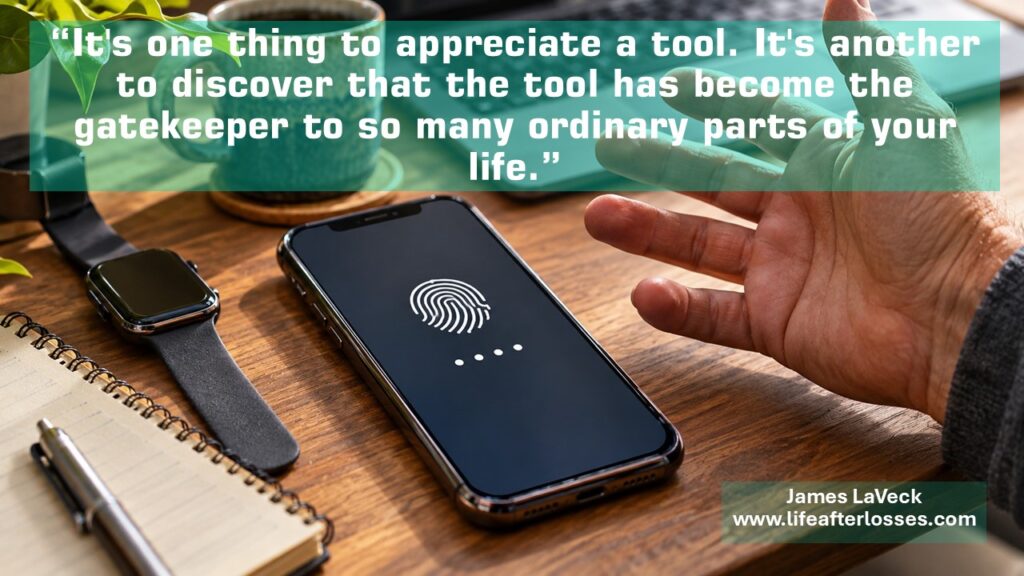
What bothers me a little is how much control I’ve handed over without really noticing. It’s one thing to appreciate a tool. It’s another to discover that the tool has become the gatekeeper to so many ordinary parts of your life.
I could tell you I’ve resolved to simplify everything and reclaim my independence from the little rectangle in my pocket. But that would be a rather ambitious claim from someone who just spent an unreasonable amount of time getting a whole bunch of apps working again.
The truth is, I’m relieved. Most things are restored. I can access my accounts, use my apps, and go about my day without being repeatedly asked to prove I’m the same person I’ve been for nearly sixty years. I’m also genuinely enjoying the new phone — it’s faster, shinier, and has features I’m still discovering. I’m a technology enthusiast. I like a new gadget as much as anyone.
But I am looking at it a little differently now. There’s a certain irony in realizing how dependent you’ve become on something while simultaneously being delighted to have an even newer version of it. I can appreciate what technology makes possible while being more aware of how much I’ve entrusted to it. I don’t have to abandon the convenience to recognize the trade-off.
And maybe I’ll give some thought to what happens the next time a device decides to retire without notice.
For now, though, everything seems to be working. My apps are happy. My authenticators are authenticated. My fingerprint has apparently passed its latest background check.
And as far as I can tell, I’m still me.
Although I suppose I should wait for the verification code before making that official.
Your Turn
Have you ever lost access to something you rely on every day and realized just how much you depended on it — a phone, a computer, a vehicle, some other convenience you barely thought about until it stopped working?
What did it reveal about what you’ve come to rely on? And did it change anything about how you use it?