We all have a past.
Some chapters we revisit with a smile—the ones that make us feel proud, nostalgic, maybe a little wistful for simpler times. Others we barely mention aloud, the ones we skim over when people ask about our story. Some we carry close like treasured photographs, while others—well, we’d rather pretend they never happened, wouldn’t we? Shove them in the back of some mental drawer and hope they stay there.
And sometimes, when life quiets down or throws us completely off balance, those older versions of ourselves come knocking again, uninvited and unannounced. They show up in moments when we least expect them—during a song on the radio, a scent that catches us off guard, or in those vulnerable 3 AM hours when our defenses are down and our thoughts run wild.
For years, I judged myself mercilessly by the person I used to be—especially in the messy, chaotic aftermath of my first major loss. The mistakes I made weren’t small ones. They were the kind that left marks, the kind that made people worry about me in hushed conversations I wasn’t supposed to overhear.
I drank too much. Smoked too much. Pushed away everyone who tried to help because accepting help felt like admitting I was broken beyond repair. I wanted to disappear entirely some days, convinced that the world would be better off without the mess I’d become. I was angry at everything—at life, at loss, at the unfairness of it all. I was grieving in the most destructive ways possible, doing everything “wrong” except for one crucial thing: I found a support group.
That single decision—showing up to a circle of other survivors—is one of hte things that probably saved my life. But everything else? It was a disaster. And for years afterward, I carried that version of myself like evidence of my fundamental inadequacy.
Maybe you’ve done that, too. Looked back at your past self through the lens of who you are now and winced at what you see. Replayed old choices like they were proof that you’re not “doing this healing thing” fast enough, or that you’re somehow fundamentally flawed in your ability to cope with life’s curveballs.
But here’s something I’ve had to learn (and re-learn—and if I’m being honest, re-re-learn on the particularly difficult days):
You are allowed to outgrow your past without being ashamed of it.
You are allowed to heal beyond what once broke you.
You are allowed to stop letting yesterday define what’s possible today.
Your past? It shaped you, absolutely. But it doesn’t get to keep you stuck there forever.
When Our Messiest Selves Serve Us
Here’s what took me years to understand: that destructive, desperate version of myself wasn’t just making mistakes; it was also a product of my own actions. He was also learning. Every wrong turn, every poor decision, every moment of hitting rock bottom was teaching me something essential about what I needed, what I couldn’t survive without, and what I never wanted to experience again.
When my second major loss hit—because life, apparently, has a twisted sense of humor—I responded completely differently. Not because I was suddenly enlightened or had figured it all out, but because I’d already lived through my own worst-case scenario. I knew what it felt like to nearly lose myself in grief, and I was determined not to go back there, for myself and our children.
I reached out instead of isolating. I asked for help before I was drowning. I honored my pain without drowning in it. The person I’d been during my first loss—the one I’d spent years being ashamed of—had actually taught me how to survive the second one.
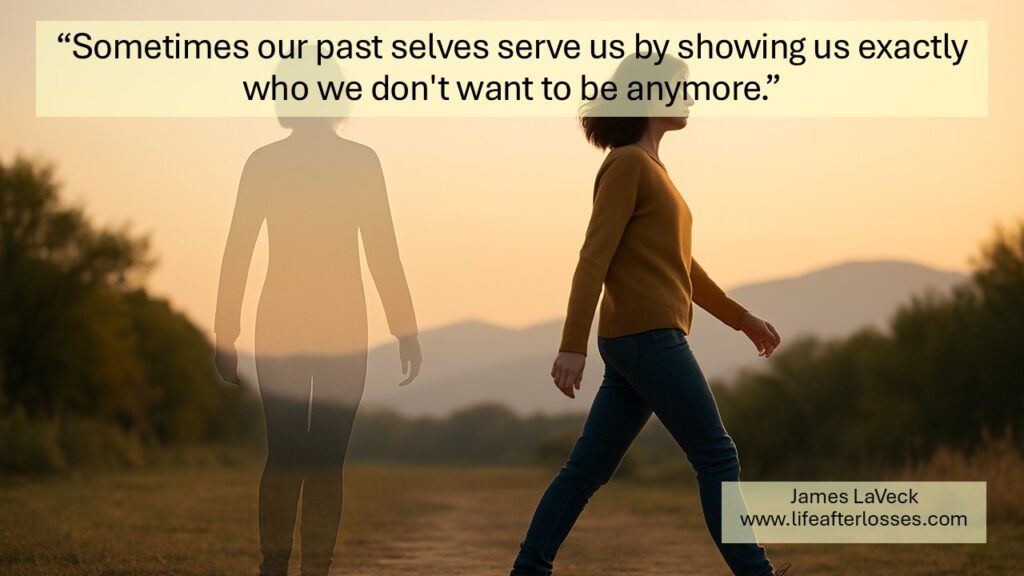
Sometimes our past selves serve us by showing us exactly who we don’t want to be anymore. Sometimes they serve us by revealing our resilience in the most unexpected ways. And sometimes, they serve us simply by proving that we can survive our own worst moments and still find our way back to something resembling hope.
Rewriting Your Relationship With Yesterday
Sometimes, the biggest shift isn’t about changing your story—it’s about changing the way you relate to it. Instead of asking, “Why did I do that?” maybe ask, “What did I need back then?” Instead of thinking, “I should’ve known better,” consider, “I did the best I could with what I knew at the time.”
That’s not letting yourself off the hook for genuine mistakes or harm caused. That’s extending compassion to the version of you that was just trying to survive. And isn’t that what we’re still doing, in some way? Learning how to survive—and maybe, eventually, thrive—on new terms?
You are not who you were five years ago.
You are not the same person you were before the loss.
You are not even the same person you were yesterday.
So if you’ve been dragging your old story like a weight behind you, carrying it everywhere you go like some kind of penance you think you deserve…
You can put it down now.
Practical Steps for Letting Go
Start with recognition. Acknowledge what that past version of yourself was trying to do. Were they trying to protect you? Numb the pain? Maintain control in an uncontrollable situation? Thank them for their service, even if their methods were flawed.
Identify the lessons. What did that experience teach you about your limits, your needs, your values? How has it informed better choices you’ve made since? Write these down if it helps—sometimes seeing the growth on paper makes it more real.
Practice the pause. When that old shame spiral starts (“I can’t believe I did that,” “I’m such an idiot,” “I should have known better”), pause. Take a breath. Remind yourself: “That was then. This is now. I am not the same person.”
Reframe the narrative. Instead of “I was a complete mess,” try “I was learning how to survive something I’d never experienced before.” Instead of “I made terrible choices,” consider “I made choices that didn’t serve me, and I’ve learned from them.”
Focus forward. Ask yourself: What’s true for me now? What do I want to carry forward from my past experiences? What wisdom did I gain that I can use today? What can I finally let go of?
Look, you don’t live there anymore—in that old pain, in those old patterns, in that old version of yourself that was doing the best they could with what they had.
You live here. In the present. In the choices you make today. In the quiet progress, the messy courage, the honest steps forward that no one else might notice but that matter enormously.
Because healing isn’t about erasing the past or pretending it never happened. It’s about rewriting your relationship to it. It’s about choosing to build a life that honors where you’ve been—the beautiful parts and the broken parts—without being held hostage by any of it.
You’ve already come farther than you think.
Now keep going.
What’s one belief, story, or version of yourself you’re ready to leave behind? What did that past self teach you that you’re grateful for now?