This past week, I marked a milestone: it’s been 30 years since my introduction to life as a widower. Three decades of trying to make sense of something that doesn’t make sense. Three decades of learning how to navigate not only loss, but life after loss.
Spoiler alert: I’m still learning how to navigate life.
And after all this time, here’s what I know: the learning doesn’t stop. It just deepens. It gets quieter. Sometimes, it even gets kinder.
I’ve learned that you can’t live in the past. You can’t live in the future. The only place you can actually live is the now—this moment, the one you’re in. That doesn’t mean you forget the past or stop dreaming about the future. But the only place you can actually influence anything is here.
And speaking of influence, I’ve learned that no matter how much I want it to make sense—not just the first loss, but my second and all the others—I have to accept that there is no making sense of it. Sometimes meaning shows up later. Sometimes it doesn’t show up at all. And I’ve learned to live with that. It took 25 years to realize that without my first loss, I wouldn’t have been able to navigate the second.
I’ve learned that asking for help isn’t a weakness. It’s actually strength in its most honest form. It’s saying, “I can’t do this alone, and I shouldn’t have to.” The moments I’ve reached out—to friends, to professionals, to strangers in support groups—have been the moments that stitched me back together.
I’ve learned that connection and relationships matter more than we think. We don’t just survive loss through inner resilience; we survive through the people who hold space for us, remind us we matter, and love us without needing us to be “fixed.”
I’ve learned that being true to yourself—your identity, your needs, your truth—is the most liberating thing you can do. That approval isn’t required. That other people’s discomfort is not your responsibility. If you want to say your loved one’s name, say it.
I’ve learned that the heart has an unlimited capacity for love. That each love is different, sacred in its own way. That losing one person doesn’t close the door to loving another. That joy doesn’t replace grief; it grows alongside it.
I’ve learned that life is cyclical. That even when it feels like the storm will never end, the seas eventually settle. And even when they rise again, you’re more prepared than you were the last time.
I’ve learned that dreams matter, even the ones that feel unrealistic. That chasing them (even halfway) adds life to your days. And that the journey always mattered more than the outcome.
I’ve learned not to take life too seriously. The universe has a sense of humor, and none of us are getting out of here alive. So you might as well find reasons to laugh along the way.
When the Calendar Stops Being a Minefield
For years, the calendar felt like I was navigating a field of hidden explosives. Birthdays, anniversaries, the day it happened, holidays we used to share. Each date approached like some named hurricane I could see coming from miles away, and I’d brace myself for the inevitable impact.
But somewhere along the way, something shifted. Those dates didn’t disappear (August 14 still exists, after all), but instead of dreading them, I started approaching them differently. Instead of steeling myself for pain, I began asking: How do I want to honor this day? How do I want to remember? What would feel right?
Some days it’s as simple as lighting a candle or playing their favorite song. Other days it’s more elaborate. But the key change? I stopped waiting for the pain to hit and started choosing how to meet these moments. This is when I chose to decide how I wanted to feel and plan for the day. The grief is still there, but it’s now wrapped in gratitude, connection, and even celebration of what was.
The Unexpected Teacher
Somewhere in the middle of this journey, something remarkable happened that I never saw coming. People started reaching out—emails, reviews of the books I’d written, messages from strangers who’d found my words somehow, somewhere. They’d tell me how something I’d shared had helped them feel less alone, had given them permission to grieve in their own way, had shown them that survival was possible.
And honestly? I never expected it. I was caught completely off guard. I’d been so focused on my own healing, my own figuring-it-out, that I hadn’t realized I was inadvertently becoming someone who could hold space for others walking similar paths. There’s something both humbling and healing about realizing that your worst experiences can become someone else’s lifeline. That the very things that nearly broke you can be transformed into tools that help repair others.
Healing isn’t just a personal journey. We heal in community, through connection, by witnessing each other’s stories and realizing we’re not as alone as we thought.
Who Am I Now? (Plot Twist: I’m Still Finding Out)
Here’s something that caught me by surprise in recent years: I thought I knew who I was. After 30 years of grief work, of therapy, of writing and reflecting and processing, I figured I had a pretty solid handle on my identity. But then I started doing something that felt both terrifying and necessary. I started actively seeking new connections, new friendships, even opening myself to the possibility of romantic relationships again (which is scary in itself).
And wouldn’t you know it? I’m discovering parts of myself I didn’t even know existed. I’m 58 years old, and I’ve found myself performing, speaking publicly, being more comfortable in my own skin than I’ve ever been. I’m exploring interests and aspects of my personality that got buried somewhere along the way, whether in the intensity of early grief or just in the business of surviving.
It’s fascinating, if not maybe just a little disorienting. It’s like meeting yourself for the first time, even though you’ve been living in the same body for decades. I’m learning that identity isn’t fixed, that even after major losses reshape us, we can continue evolving, continue surprising ourselves with who we’re capable of becoming.
Still Their Presence
Through all of this—the calendar shifts, the helping others, the self-discovery—there’s been one constant: I still feel their presence. Not in a mystical, supernatural way necessarily, but in the way their influence continues to shape how I move through the world. In the way they loved me that taught me how to love others. In the memories that still make me smile at unexpected moments.
They’re intertwined into who I’ve become, into the work I do, into the ways I show up for other people. And maybe that’s part of what I’ve learned too—that love doesn’t end with death. It transforms, taking on new shapes, but it doesn’t disappear. It becomes part of the foundation you build the rest of your life on.
So after 30 years, am I “done” grieving? No.
But I’ve become fluent in the language of life after loss. I’ve become more curious. More compassionate. More willing to keep going, even when the road still twists and turns. More interested in what’s possible than what’s been lost.
And maybe that’s the biggest thing I’ve learned:
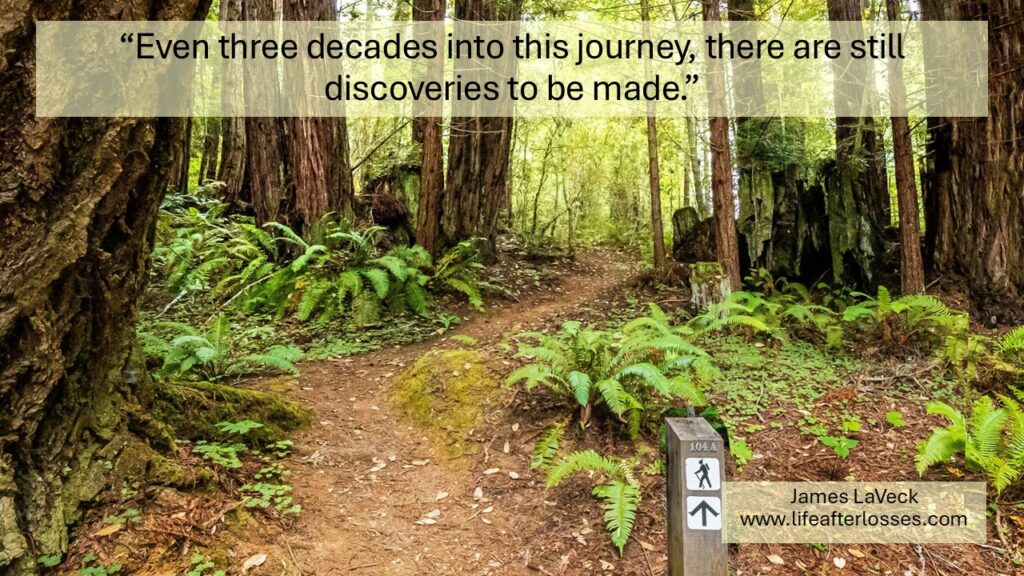
That it’s okay to still be learning. That growth doesn’t have an expiration date. That even three decades into this journey, there are still discoveries to be made, connections to be forged, parts of yourself to uncover.
The best chapters might still be unwritten.
Here’s your weekly thought: What’s one thing you’ve learned on your own path through grief or healing?