This time of year does something to me.
Between the holidays and a cluster of anniversaries, memories surface whether I invite them or not. Some arrive soft as a butterfly. Others land like a weight. And lately, I’ve been moving back and forth between gratitude for the life I’ve built and sorrow for the life that ended 12 years ago.
Both are real. Both belong here.
There was a time when I thought the presence of sorrow meant something was wrong with me. That maybe I wasn’t as healed as I thought. That maybe I was sliding backward.
I don’t believe that anymore.
When Grief Shows Up Years Later
We have this unspoken rule about grief, don’t we? That once you’ve done enough “work,” certain feelings should stop showing up. That if you’re still sad years later, you must be stuck. That grief returning means you’ve failed at moving forward.
But here’s what I’ve learned: Sorrow resurfacing isn’t regression. It’s memory with a heartbeat. It’s love with nowhere to go. It’s your nervous system remembering what mattered. And sometimes, it’s simply what happens when life slows down enough for feelings to catch up.
The sorrow itself isn’t the problem. What can cause trouble is what we do when it arrives.
Because there’s a difference between acknowledging sorrow and surrendering your entire day to it. And that difference took me years to understand.
The Weight of January 24th
On January 24th, it will be twelve years since I lost my second husband.
That date still carries weight. It always will. I don’t want it not to.
But I’ve learned something about these anniversary dates, these memory ambushes, these moments when past and present collide. I used to think that if grief showed up, I had to give it the microphone. Let it narrate everything. Let it decide how the rest of the day would go.
That felt like the only honest response. Like anything else would be betrayal.
Now I know differently. Honesty doesn’t require drowning. Feeling something doesn’t mean I have to live there all day. I can acknowledge sorrow without letting it rearrange my entire life every time it visits.
New Year’s Eve in a Crowd
This just happened to me. New Year’s Eve, surrounded by friends and strangers, music pounding, everyone counting down to midnight. And when that ball dropped, I felt completely untethered. Lost. The contrast between all that celebration and the grief that suddenly surfaced was almost unbearable.
For a moment, I was ready to leave. To go home and let the sadness have its way with me. To curl up with the familiar ache of missing what I’d lost.
But I didn’t. I stayed. Not because I was being brave or strong or any of those words people use. But because I’ve learned something crucial: I can hold sorrow without letting it hold me hostage.
Standing there in that club, I actually said it out loud (though no one could hear me over the music): “Feeling sad doesn’t mean I’m failing. It doesn’t mean I’m going backward. It means I’m human. It means I loved deeply. And that’s okay.”
Then I let myself feel it for another moment. And another. And then… I chose to come back to the friends beside me. To the music. To the night that was still happening.
The Compassionate Interruption
This is what practice looks like for me now:
I notice the pull toward the darkness. I name what’s happening without judgment: “Oh, here’s grief again. Here’s that anniversary sorrow.”
And then I interrupt it. Gently, but deliberately.
Not with denial. Not with toxic positivity. Not with “they’d want me to be happy” (though he would). But with a kind of loving responsibility. Responsibility to the life I’m still living. To the people still here. To the person I’ve worked so hard to become.
Sometimes that interruption is redirecting my attention to something tangible – the music, a friend’s laugh, the feeling of my feet on the ground. Sometimes it’s doing something physical. Sometimes it’s just reminding myself that I’m allowed to feel sad AND I’m allowed to choose what I do with that sadness.
You Can Feel It Without Drowning
Here’s the thing I want you to know if you’re navigating your own version of this:
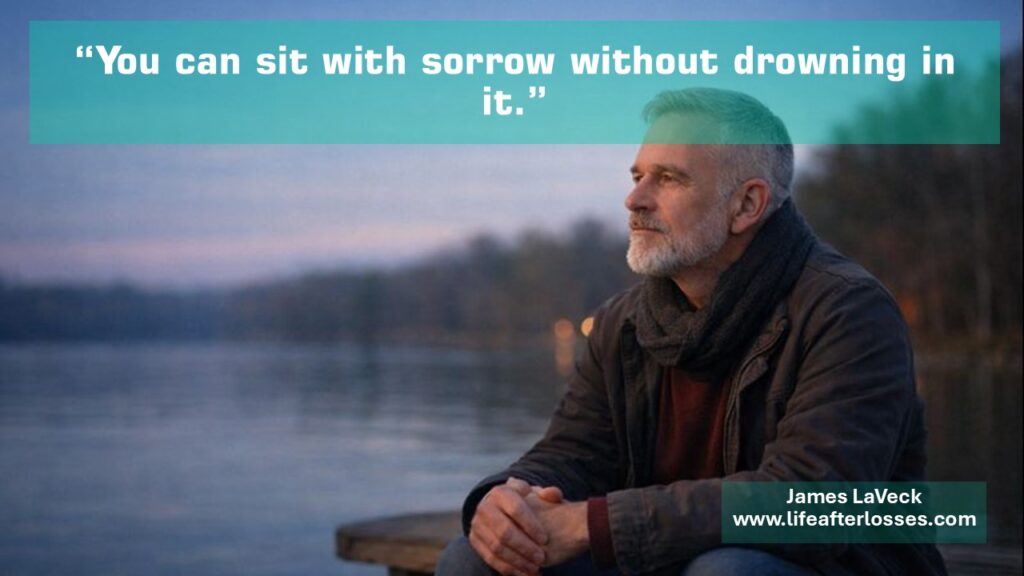
You can sit with sorrow without drowning in it. You can honor what you’ve lost without letting it dominate every anniversary, every holiday, every quiet moment. You can feel grief and still choose to be present for your life.
This isn’t about “moving on” or “getting over it.” I hate those phrases. They imply leaving something behind, and that’s not what this is.
This is about learning to carry it differently. To let grief visit without letting it redecorate. To feel the weight without letting it pin you down.
Interrupting the spiral doesn’t mean you’re avoiding grief. It means you’re tending to it responsibly. Like the difference between acknowledging a crying child and letting them run the household.
Grief deserves care. It doesn’t deserve complete control.
Your Turn
If this touches something in you, here’s my invitation to you this week:
When sorrow shows up, notice it. Name it. Let it exist without judgment, like I did on New Year’s Eve.
Then ask yourself: “What do I need right now to stay anchored in the life I’m actually living?”
Sometimes the answer is a good cry. Sometimes it’s a walk. Sometimes it’s reaching out to someone. Sometimes it’s staying right where you are and choosing to be present, even when you’re sad.
You’re allowed to feel what you feel. You’re also allowed to redirect when feeling turns into sinking.
That’s not betrayal. That’s not denial. That’s growth. That’s maturity. That’s learning how to live with loss without letting loss live through you.
This has been my journey through life after losses – learning to navigate those activating moments without letting them capsize me. Maybe that’s why people say I’m resilient or strong.
But really? I think it’s just that I’ve learned sorrow means I loved deeply. And loving deeply doesn’t disqualify me from living fully now.
Both can be true. Both are true.
And that’s enough.