Can I admit something that used to frustrate me when I was grieving?
People would ask how I was doing when they didn’t actually want an honest answer.
Not everyone. Some people genuinely cared. Some people knew how to sit with another human being in real pain without trying to rush them out of it. Those people were rare, and I was grateful for every single one of them.
But a lot of people were asking out of habit. Politeness. Social obligation. It was just part of the script.
“How are you?” “Fine.” “Good to hear.”
Conversation over.
The problem was… I wasn’t fine. Not even a little bit.
And after a while, it became exhausting trying to decide in real time whether to give the socially acceptable answer or the truthful one. So I started doing something that I’m sure made a lot of people uncomfortable. When someone asked how I was doing, I’d look at them and say, “Do you really want to know? Or are you just being polite?”
That changed the energy in the room pretty fast.
Most people looked uncomfortable. Some laughed nervously. A few actually admitted, “No, not really.”
And honestly? I respected that. At least it was the truth.
What was harder to sit with was realizing just how uncomfortable real emotion makes people. Especially grief. Especially sadness that lasts longer than other people think it should. Because there is absolutely a pressure in our culture to appear okay. To move forward. To stay positive. To show progress. And if enough time passes, people start expecting your pain to get quieter, smaller, more manageable for them to be around.
Not because they’re bad people. I genuinely don’t think that’s it.
I think most people just don’t know what to do with pain they can’t fix. So they look for signs that you’re getting better. And when you’re not, when you’re still right in the middle of it, the conversation gets awkward and they find a reason to move on.
And that pressure doesn’t just show up in grief. It’s everywhere.
People post happy moments while privately falling apart. People say they’re good because explaining the truth feels like too much work. People smile through burnout, loneliness, anxiety, depression, and emotional exhaustion because they don’t want to make anyone else uncomfortable.
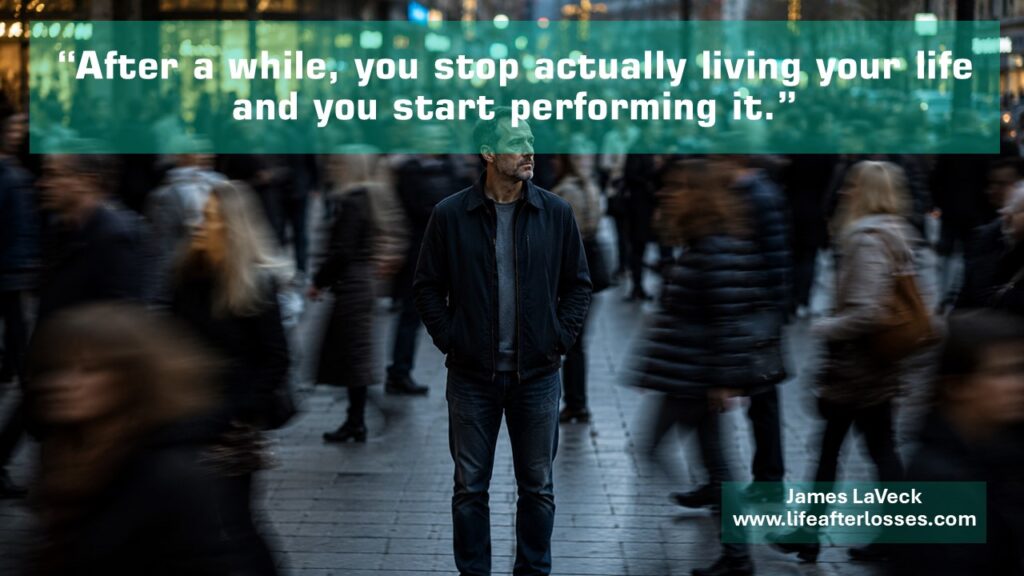
After a while, you stop actually living your life and you start performing it.
And that performance takes energy. A lot of energy. Energy most of us don’t have to spare.
I think that’s part of why so many people feel so disconnected from themselves right now. They spend so much time managing how they appear that they genuinely lose touch with how they actually feel. And that disconnect creates a constant internal friction — not because difficult emotions are wrong, but because pretending not to have them is exhausting in a way that compounds over time.
You start editing yourself in real time. You measure your honesty by how comfortable it will make someone else. And eventually… that gets very lonely.
One of the things grief taught me is that healing and performance are not the same thing. Looking okay is not the same as being okay. And positivity isn’t always healthy if it requires you to abandon what’s actually real.
I remember a coworker named Rose asking how I was doing after Bob died. When I asked her my usual question, “Do you really want to know?”
She said, without hesitating, “Of course I do.”
So I told her the truth.
I told her I hated my life. That I hated living like that. That I wished I could have him back, and I hated crying all the time, and I didn’t know how to do any of this.
And once I started talking, the tears came too.
Rose didn’t try to fix it. She didn’t rush me toward the bright side. She didn’t tell me that everything happens for a reason or that I needed to stay strong. She just hugged me and said, “It’s okay. It’s understandable.”
I still think about that moment.
Not because she solved anything. She didn’t. But for a few minutes, I didn’t have to perform being okay. I could just be honest. And I cannot tell you how much that mattered.
I think a lot of people are starving for exactly that. Not advice. Not correction. Not someone handing them a reframe. Just the ability to tell the truth about where they are without feeling like they’re failing some invisible happiness test.
Maybe that’s part of healing, too — finding the people and spaces where you don’t have to perform your way through pain.
And maybe happiness becomes more possible when honesty finally has enough room to breathe.
Your turn
For this week, I’d like you to ponder this: How often do you answer “I’m fine” on autopilot? Where do you feel pressure to appear okay when you’re not? Who in your life actually makes it safe to answer honestly?
And are you giving yourself permission to tell the truth about how you actually feel?