One of the things I’ve told my kids for years is this: if you’re going to fail, fail spectacularly.
That usually gets a laugh the first time people hear it. It sounds like I’m encouraging bad decisions or reckless behavior. I’m not. What I’m actually encouraging is the willingness to try in the first place.
Because over the years, I’ve noticed something. Most people aren’t held back by a lack of ability. They’re held back by a fear of failing. They don’t avoid the thing because they can’t do it — they avoid it because they might not do it well. And that’s a completely different problem than the one they think they have.
I have a friend who recently got into competitive shooting. He’s good. Really good, actually. But despite his success, he’s still very much learning. Every competition shows him something he could do better. Every missed shot, every mistake, every result that wasn’t quite what he wanted — it all becomes information he uses next time. He doesn’t see those moments as proof he shouldn’t be doing this. He sees them as just part of how it works.
Somewhere along the way, a lot of us start treating failure like it’s something to avoid at all costs. We start treating mistakes like verdicts instead of lessons. If something doesn’t work the first time, we assume we’re not good at it. If we’re not immediately successful, we question whether we should even keep going.
But think about how strange that actually is.
Nobody expects a kid to ride a bike perfectly on the first try. Nobody expects a teenager learning to drive to already know everything. Nobody expects a brand-new employee to master a job on day one. And yet somehow, as adults, we expect exactly that from ourselves. We want confidence before we’ve gotten any experience. We want competence before we’ve put in the practice. We want the success before we’ve actually done the work that earns it. I couldn’t play piano on Day One, but I practiced.
A few years ago, I joined a musical revue with a local theater group. It sounded fun in theory. Then rehearsals started, and it got a lot more intimidating, fast. I wasn’t just learning songs — I was learning choreography, staging, movement, timing. I had to remember where I was supposed to be and somehow make all of it look natural in front of an audience.
There were moments I felt completely out of my depth. And if I’m being honest, there were moments I felt I just wasn’t very good. That’s the part you hardly ever hear about. Learning something new almost always guarantees a stretch where you’re not particularly skilled at it. That’s not failure. That’s just the process doing exactly what it’s supposed to do.
The hard part is that most adults have spent years building a life around competence. We know how to do our jobs. We know our routines. We know the rules of the rooms we spend most of our time in. Being a beginner blows all of that up. Suddenly, you’re asking questions that feel obvious. You’re making mistakes in front of people. You’re finding gaps in your knowledge that you didn’t realize existed. So it’s tempting to just retreat back to what you already know how to do.
A lot of people do exactly that. Not because they’re lazy or incapable, quite the opposite. They retreat because protecting your sense of competence usually feels safer than risking failure.
But here’s the thing: growth lives only on the other side of that discomfort.
Every meaningful thing I’ve done required me to be willing to fail at it first. Learning how to play the piano. Writing my first book. Returning to acting after almost thirty years away. Stepping onto a stage in front of a live audience for that first revue. None of it started with confidence. It started with uncertainty. The confidence came later, after I’d already shown up enough times to earn it.
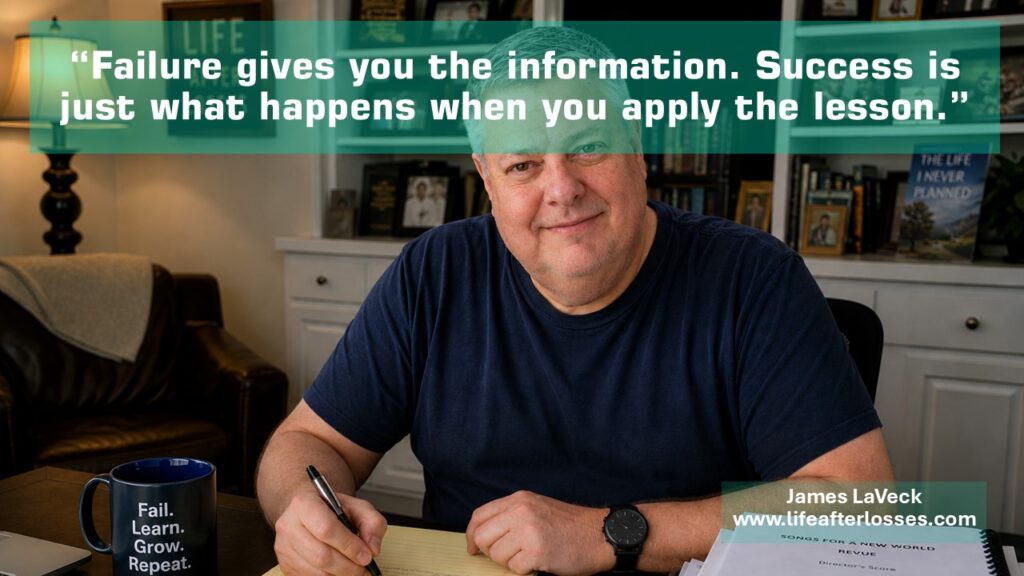
What I’ve learned is that failure and success aren’t opposites. They’re partners. Failure gives you the information. Success is just what happens when you apply the lesson. The people who grow the most aren’t the ones who avoid failing; they’re the ones who stop treating failure like a verdict on who they are.
There’s a real difference between saying “I failed” and saying “I am a failure.” One describes something that happened. The other turns it into an identity. And identities are a lot harder to walk back from than events are.
Every skill you’ve ever built required you to be bad at it first. Every person you admire has a long list of failures they rarely bring up. The question isn’t whether you’ll fail — you will. The question is whether you’ll actually listen to what it’s trying to tell you.
Your Turn
Think about something you’ve been hesitant to try. What’s actually holding you back — the challenge itself, or the chance that you won’t do it well right away? What might change if you stopped treating mistakes as proof you should quit, and started treating them as proof you’re still learning?
Sometimes the lesson isn’t that you’ve hit your limit. Sometimes the lesson is just that you’re not done yet.